
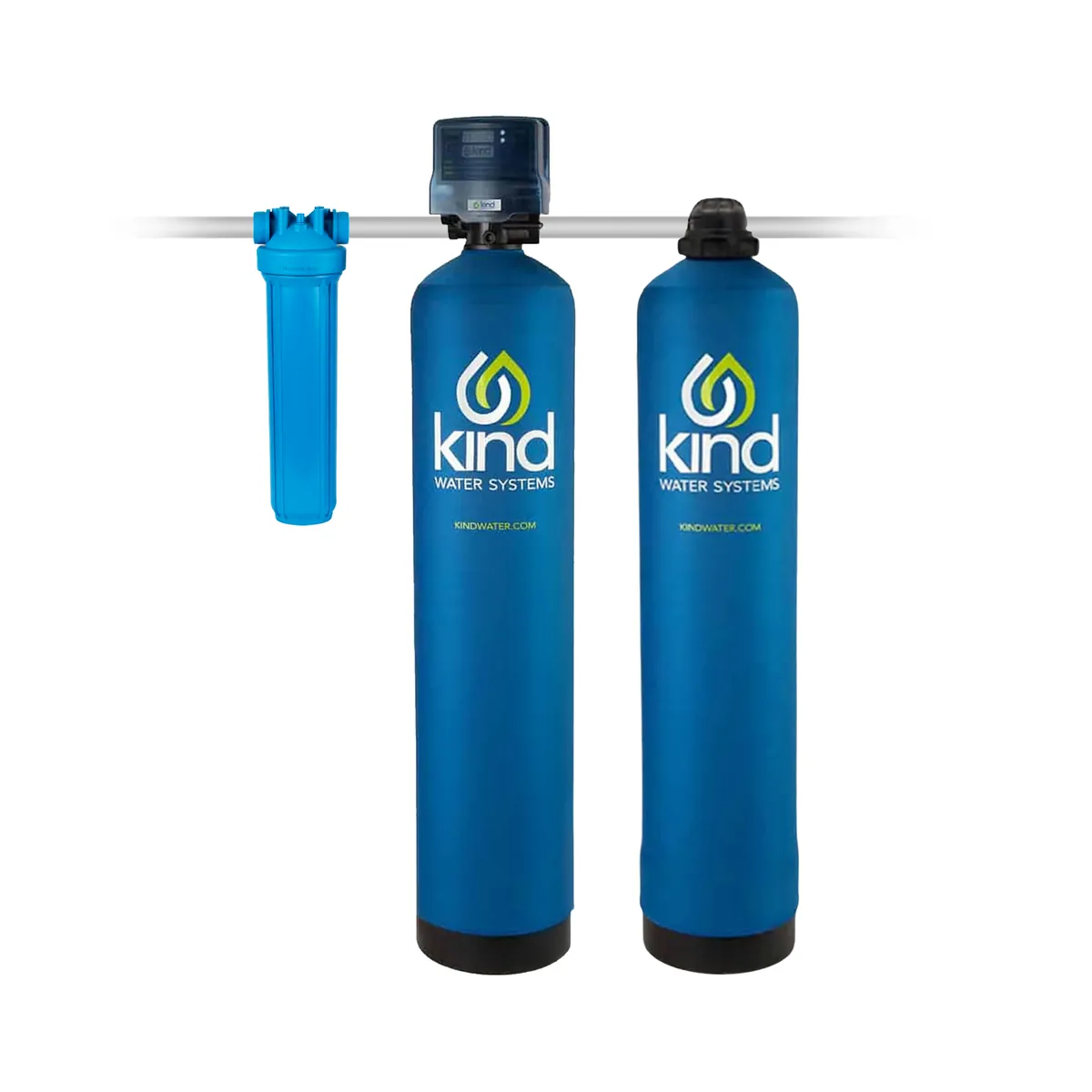
Independent review: We may earn a commission if you purchase through our links. Our ranking is not affected by compensation. This review is based on manufacturer specifications, certification records and published pricing — not hands-on testing.
Important correction (Oct 2026): The WS-6000 is not an iron or sulfur treatment system. Kind’s specifications list 0 mg/L maximum for iron, hydrogen sulfide, and manganese. If your well water has iron or sulfur, you need a dedicated oxidation/filtration system (like the SpringWell WS1), not the WS-6000.
Hands-on tested: No.
The short answer: The Kind WS-6000 is Kind Water’s answer to the well-water version of the E-3000 — a single system that handles filtration and scale conditioning together without salt, at roughly $2,824 in equipment plus $300–$600 for professional install. It makes sense for well owners whose biggest complaints are rotten-egg smell, orange staining, and scale buildup, and who want one box instead of three. But it is not a blanket fix for well water: iron and sulfur levels determine everything, so a lab test comes before any purchase. And Kind publishes no whole-system NSF certification data for this model, which we’re stating plainly because it’s the kind of thing that matters once you compare specs honestly.
Best for: Well-water homes with sediment and chlorine issues who also want salt-free scale conditioning — who want a salt-free, low-wastewater setup and are willing to pay a premium for it.
- Equipment: ~$2,824
- Service flow: 12 GPM
- Function: Sediment + carbon filtration + salt-free conditioning (NOT for iron/sulfur)
- Warranty: Lifetime
- 10-year cost: $4,624–$5,924
Our take
Well-water problems rarely arrive one at a time. The rotten-egg smell (sulfur), the orange toilet rings (iron), and the crusty fixtures (scale) tend to show up together — which is why well-water treatment usually means a stack of equipment: an iron/sulfur filter, then a softener, then maybe a filter for taste. The WS-6000’s entire pitch is collapsing that stack into one system.
That’s genuinely appealing, and it deserves honest treatment rather than a sales patter. So here’s the honest version: on paper, the WS-6000 is a legitimate all-in-one well-water combo. The equipment price (~$2,824) sits below what you’d often pay for a separate iron/sulfur unit plus a salt-based softener plus installation for two systems. The salt-free conditioning means no salt bags, no brine discharge, and effectively zero wastewater — real advantages if your well produces limited water or your town restricts softener discharge.
But the caveats are load-bearing, so get them early:
- Your iron, sulfur, and manganese levels decide whether this works. No well-water system is a blind purchase. If your iron is at 8 ppm and sulfur is high, you may need pre-treatment this system can’t handle. Get an independent lab test ($100–$300) before spending four figures. Here’s how to test your water properly, and our iron guide explains what the numbers mean.
- Data quality on this model is estimated. Kind’s published materials for the WS-6000 are thinner than for the flagship E-3000, so some specs below are our best reading of what’s published. We say so where it matters rather than filling gaps with confidence.
- No whole-system NSF performance certification is published for the WS-6000. More on that in the certification note below.
For context on where the WS-6000 sits in Kind’s lineup: the E-1000 is filtration only, the E-2000 is conditioning only, the E-3000 is filtration + conditioning for city water, and the WS-6000 is the well-water combo. Kind uses those labels consistently — don’t let any listing muddy them.
How the WS-6000 works
The system combines two stages in one package:
- Sediment + carbon filtration. Well water passes through sediment filtration and backwashing carbon, which handles sediment, chlorine taste/odor, and other aesthetic issues. This stage does NOT treat iron, sulfur, or manganese — Kind specs list 0 mg/L maximum for all three.
- Salt-free conditioning (TAC). The second function uses template-assisted crystallization (TAC), which converts dissolved hardness minerals into tiny non-adhering micro-crystals. The scale doesn’t form crust on fixtures and pipes because the crystals won’t stick. Be clear about what this is and isn’t: TAC does not remove hardness minerals and does not “soften” water in the way a salt softener does. Your water test will still show the same hardness number afterward. What changes is whether scale accumulates.
Because there’s no salt regeneration cycle, the system produces effectively zero wastewater — a meaningful difference versus a conventional softener, which flushes brine on a schedule. (We say “zero wastewater” deliberately: it’s the measured outcome, not a claim about whether a drain connection exists.)
One more well-water reality check that has nothing to do with brands: TAC does nothing for iron and sulfur on its own. That’s why the WS-6000 exists as a combo — the iron/sulfur stage has to work before the conditioning stage means anything. If a competitor ever pitches you “salt-free conditioning” for a well with iron problems and no iron treatment, that’s a system solving the wrong half of the problem.
Specs at a glance
| Spec | WS-6000 |
|---|---|
| Function | Well-water iron/sulfur/scale treatment + salt-free (TAC) conditioning |
| Equipment price | ~$2,824 |
| Professional install | Typically $300–$600 |
| Service flow rate | 12 GPM |
| Warranty | Lifetime |
| Wastewater | Zero wastewater (no salt regeneration) |
| Salt / electricity for softening | None |
| Ongoing upkeep | ~$150–$250/yr (media/filters per published guidance) |
| Whole-system NSF certification | None published — see certification note |
Compare against the city-water sibling: the Kind E-3000 runs $1,780–$2,094 in equipment with a higher 15 GPM service flow, but it’s filtration + conditioning for municipal water — it is not an iron/sulfur treatment system. If you’re on a well, the E-3000 doesn’t do the WS-6000’s job. (See the full comparison context in our Kind Water review and whether Kind fits your situation.)
The main well-water competitor we track is the SpringWell WS1, a whole-house well filter aimed at the same iron/sulfur/odor problems. Note: SpringWell has no affiliate program with us, so the link to their site is plain — we mention it because a competitor comparison is worthless without the main competitor.
10-year cost breakdown
The sticker price is only the down payment. Here’s the decade math on published figures: Check the current WS-6000 price →
| Cost component | Estimate |
|---|---|
| Equipment | ~$2,824 |
| Professional installation | $300–$600 |
| Upkeep (media, filters) — 10 years at $150–$250/yr | $1,500–$2,500 |
| Total 10-year cost | $4,624–$5,924 |
| Annualized | ~$462–$592/yr |
What the numbers mean. At ~$462–$592 per year all-in, the WS-6000 costs roughly what you’d spend on a salt softener once you add bags of salt, the water it flushes, and periodic service — except the maintenance here is media/filter swaps instead of salt runs. Where it wins on cost is against a two-system stack: buying and installing an iron/sulfur filter plus a separate softener commonly runs past $5,000 installed before a decade of salt and upkeep. If your well only needs softening and has no iron or sulfur problem, though, you’re paying for treatment you don’t need — match the system to the test results, not the brochure. (More on whole-house filter costs across system types.)
Who should buy it — and who should skip it
Buy it if:
- You’re on a well and your water test shows a combination of iron, sulfur odor, and hardness/scale — the combo this system is built for.
- You want to avoid salt: no bags to haul, no brine discharge, and zero wastewater.
- You’d rather maintain one system than coordinate an iron filter plus a separate softener.
- The lifetime warranty matters to you (read the actual terms — “lifetime” warranties always have conditions).
Skip it if:
- You haven’t had a lab test. This is non-negotiable for well water: iron, sulfur, and manganese levels determine whether any system in this category works, including this one.
- Your test shows iron/sulfur levels above what a single combo unit can handle — you may need dedicated pre-treatment, and no amount of warranty fixes the wrong equipment.
- You’re on city water. The E-3000 is the sibling built for that job, at lower equipment cost and higher flow.
- You actually want softened water (zero-grain feel, soap lathering like a salt system). TAC prevents scale; it doesn’t soften. If the feel of soft water is what you’re after, a salt softener is still the honest recommendation — and we’ll tell you that even though we earn more on this link. A competitor that fits better is a competitor we name: check the system finder to compare by your actual water profile.
- You need certified performance documentation for a specific contaminant (see below).
Certification note
One clear statement: Kind publishes no whole-system NSF/ANSI performance certification data for the WS-6000 specifically. This doesn’t mean the system doesn’t work — plenty of legitimate treatment equipment lacks system-level certification. But certification is how a manufacturer proves performance claims to a third party, and its absence means you’re trusting the spec sheet alone. If any listing or salesperson claims NSF certification for this model, ask for the listing number and verify it in the NSF database yourself. We checked; we don’t re-add claims we can’t verify.
Frequently asked questions
Is the Kind WS-6000 the same as the E-3000?
No. The E-3000 is filtration + salt-free conditioning for city/municipal water. The WS-6000 is the well-water combo: iron/sulfur/scale treatment plus salt-free conditioning. Different water problems, different systems. Kind keeps the lineup clean — E-1000 (filtration only), E-2000 (conditioning only), E-3000 (filtration + conditioning), WS-6000 (well-water combo).
Does the WS-6000 soften water?
Not in the way a salt softener does. Its TAC stage converts hardness minerals into non-adhering micro-crystals so scale doesn’t build up — but it doesn’t remove the minerals, and a hardness test will read the same afterward. If you want the feel of truly soft water, a salt-based softener is the honest pick.
Do I need a water test before buying?
Yes — a lab test is mandatory homework for well water, not optional. Iron, sulfur, and manganese levels determine whether the WS-6000 (or any system) can handle your water. An independent test runs $100–$300. See how to test your water.
What does the WS-6000 cost over 10 years?
Based on published figures: ~$2,824 equipment, $300–$600 professional install, and $150–$250/year in upkeep, for a 10-year total of $4,624–$5,924 (about $462–$592/year). Data quality on this model is estimated, so treat these as planning figures.
Does it waste water like a salt softener?
No — there’s no salt regeneration cycle, so the system produces effectively zero wastewater. That’s a real advantage on low-yield wells or where softener discharge is restricted.
Is the WS-6000 NSF certified?
No whole-system NSF/ANSI performance certification is published for the WS-6000. If certified performance matters for your situation, verify any claim against the NSF database directly.
What warranty does Kind offer on the WS-6000?
Kind advertises a lifetime warranty. As with all “lifetime” warranties, read the actual terms and conditions for what’s covered, what’s excluded, and what voids it before you factor it into the buying decision.
The bottom line
The WS-6000 is a credible one-box answer to the most common well-water complaint bundle — iron staining, sulfur smell, and scale — at ~$2,824 plus install, with zero wastewater and no salt to manage. It’s the right shape of product for well owners who want the combo without assembling a multi-system stack.
It is not a blind purchase. Lab-test your water first, match the system to the results, understand that TAC prevents scale rather than softening, and know that no whole-system certification is published for this model. If your test comes back with a problem set this system matches, it’s worth a serious look — and if it doesn’t, the Find Your System quiz or the system finder will point you at what does. For the broader landscape, see our best whole-house water filters roundup.