Last reviewed: September 22, 2026
Affiliate disclosure: This site earns commissions when readers buy through affiliate links — we’ll be adding them to this page soon. For now, every product link goes directly to the manufacturer’s official page. Commissions never influence our rankings or verdicts; the picks below are what we’d recommend either way.
Prices and terms checked September 21, 2026. Prices move — especially around sales — so treat every figure below as a snapshot and confirm before you buy.
How we evaluate: We don’t own a test lab, and we didn’t plumb five systems into one house. This guide is a research synthesis: manufacturer-published specs, certification claims (we always say whose claim it is), warranty and maintenance terms, and patterns across verified buyer reviews. Where we cite performance data, we name the source.
Here’s the fastest way to waste $1,500 on a whole house water filter: buy the highest-rated one without knowing whether you’re treating city water or well water. They are different problems. A system that’s excellent for chlorinated municipal water can do nothing for iron-heavy well water, and vice versa.
So before anything else: test your water. A lab test runs $100–$300. On municipal water, your city’s free annual Consumer Confidence Report covers the basics. Either way, know what you’re treating before you spend four figures. Everything below assumes you’ve done that — or at least know which side of the city/well line you’re on.
Our top picks at a glance
- Best overall (city water): SpringWell CF1 — catalytic carbon + KDF, 1,000,000-gallon capacity, lifetime warranty, ~$1,144
- Best certifications & brand trust: Aquasana Rhino EQ-1000 — NSF/ANSI 42-tested chlorine reduction, 10-year warranty, ~$1,998 (its $999 half-off summer sale ended mid-September 2026)
- Best filter + salt-free conditioner combo: Kind Water E-3000 — whole-house filtration plus salt-free scale conditioning, ~$1,885 (sale price; list $2,094 — Kind’s pricing shifts often)
- Best for well water: SpringWell WS series — built for iron, sulfur, and manganese; priced by configuration
How we choose: We evaluate filtration performance, certifications, flow rate, maintenance requirements, warranty, price, and water-type suitability, from manufacturer specs, certification databases, and patterns across verified buyer reviews. Rankings are never influenced by affiliate compensation. Read how we review products.
1. SpringWell CF1 — Best overall for city water
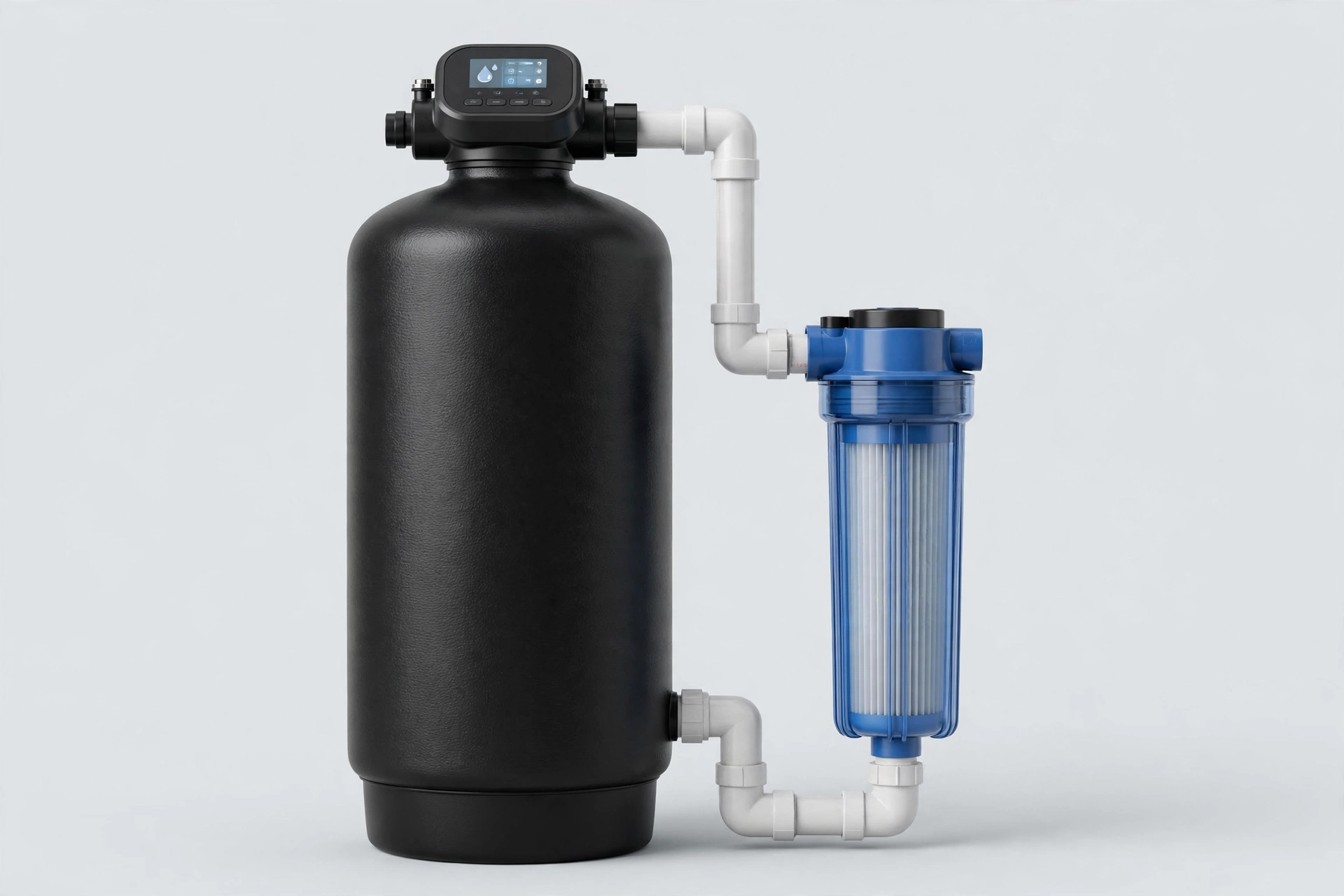
Price: ~$1,144 (approximate — third-party observed pricing, Sept 2026; SpringWell’s official page shows sale pricing but doesn’t publish readable variant prices) — check current price
Flow rate: 9 GPM (CF1, 1–3 bathrooms); 12 GPM (CF4, 4–6 bathrooms); up to 20 GPM (CF+, 7+ bathrooms)
Capacity: 1,000,000 gallons or up to 10 years (per manufacturer)
Media: Catalytic coconut-shell carbon + KDF, with 5-micron sediment post-filter
Targets (per SpringWell, not independently certified): chlorine, chloramine, PFAS (including PFOA/PFOS)
Certifications: No system-level NSF/WQA certification found for the CF line; SpringWell publishes independent lab testing, and component materials are individually certified
Warranty: Lifetime on tanks and covered components against defects; 6-month money-back guarantee (fine print: 25% restocking fee, and you pay return shipping)
Annual maintenance: ~$40 (sediment pre-filter every 6–9 months)
The CF1 is our top pick for municipal water. Not because it’s flawless. Because it handles the most common city-water complaints (chlorine and chloramine taste and odor, plus disinfection byproducts) with the least ongoing hassle in the category.
The tank design is the whole story. Instead of cartridges you’re swapping every couple of months, you get a million-gallon media bed that most households ignore for the better part of a decade. The only recurring chore is a cheap sediment pre-filter every 6–9 months.
Two things genuinely separate it from the pack. First, the catalytic carbon handles chloramine. A growing number of cities disinfect with chloramine instead of chlorine, and standard carbon struggles with it. Second, the warranty. Aquasana’s 10 years is good. Lifetime is better.
Now the honest drawbacks. It’s a big tank system, so you need space near your main line, and professional installation is the norm (budget a few hundred dollars unless you’re handy). It’s overkill if your only complaint is mild chlorine taste. A $300 under-sink system would do that job. And a word of candor on certifications: the CF line carries no system-level NSF certification. SpringWell’s evidence is its own published lab testing plus certified component materials, not a third-party badge on the finished system. If the badge matters to you, read pick #2.
Pros
- You’re on city water and want to think about your water filter roughly never.
Cons
- Your only complaint is faint chlorine taste. That’s a $300 under-sink job, not a $1,150 tank system.
2. Aquasana Rhino EQ-1000 — Best certifications and brand trust
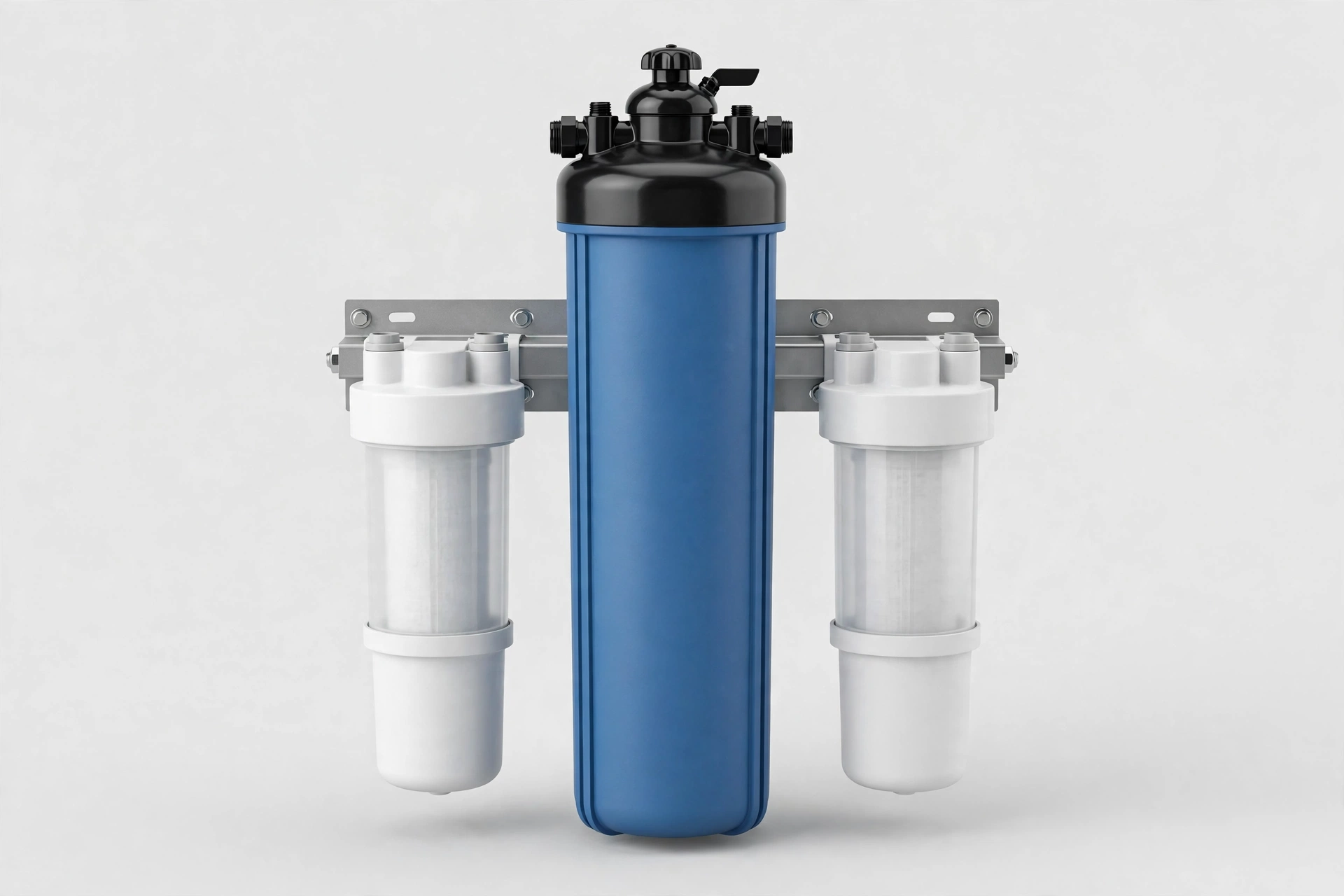
Price: ~$1,998 on aquasana.com (Sept 2026 — the $999 half-off summer sale ended around September 12, per two independent Sep 2026 sources; Aquasana runs sitewide sales repeatedly, so this may not hold) — check current price
Flow rate: 7 GPM rated; sized for up to 2.5 bathrooms / four residents per Aquasana (larger homes should look at the Rhino Max Flow line)
Capacity: 1,000,000 gallons or up to 10 years
Media: Sediment pre-filter + copper-zinc mineral stone (KDF) + activated carbon + sub-micron post-filter
Certifications (per Aquasana): independently tested to NSF/ANSI 42 for 97% chlorine reduction; tank WQA-certified to NSF/ANSI/CAN 61
Warranty: 10 years; 90-day money-back guarantee
Annual maintenance: ~$100–$120 (pre-filter every 2 months, post-filter annually)
Aquasana is the name your neighbor already knows, and the Rhino is why. Its certification story is the cleanest in this guide: independently tested to NSF/ANSI 42 for 97% chlorine reduction. That’s a concrete, third-party-backed claim, not marketing adjectives. If “show me the badge” is your buying criterion, stop here.
The Rhino’s other real advantage is the add-on ecosystem. You can bundle a UV purifier (bacteria: relevant for some wells, and for peace of mind generally) and a salt-free water conditioner onto the same platform. Nobody else packages the upgrades this cleanly.
The tradeoff is ownership cost and effort, and it’s gotten steeper. The pre-filter wants changing roughly every 2 months. About six swaps a year, versus SpringWell’s one or two, and annual maintenance runs roughly triple. Then there’s the price. At $999 this was the value story of the category. At $1,998 it costs roughly twice as much as the SpringWell to own over 10 years ($1,998 + ~$1,200 in filters ≈ $3,200, vs. $1,144 + ~$400 ≈ $1,540). Aquasana runs sitewide sales repeatedly, so the math improves if you catch one. But buy this system for the certifications and the ecosystem, not the price.
Pros
- Certifications matter to you, you want the UV or salt-free add-ons in one integrated purchase, or you trust the best-known brand in the category.
Cons
- You’re price-sensitive at $1,998 and don’t need the add-ons. The SpringWell does the core job for far less.
3. Kind Water E-3000 — Best filter + salt-free conditioner combo
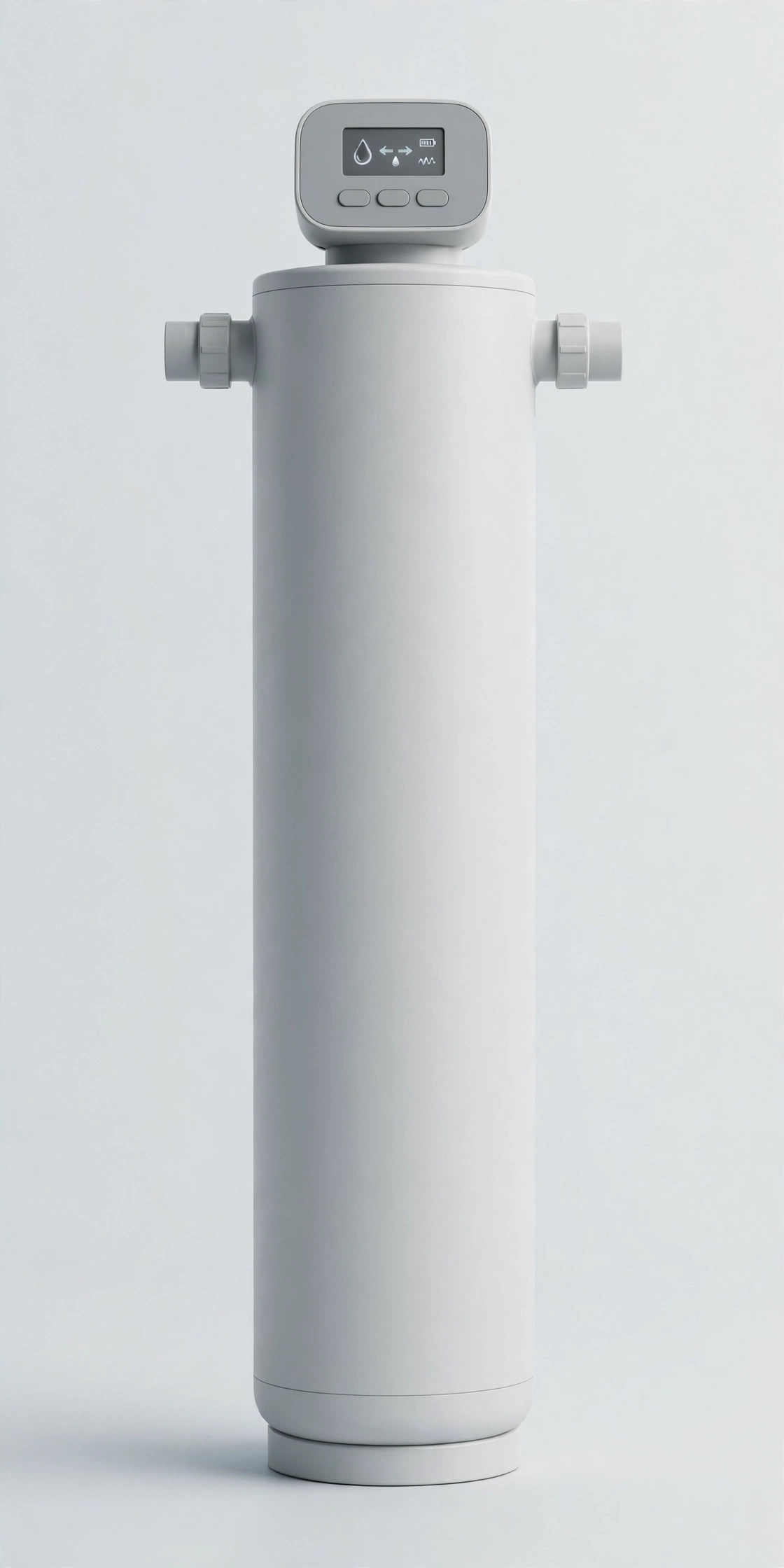
Price: ~$1,885 (Home Depot, Sept 2026 — 10% off a $2,094 list; Kind’s pricing shifts frequently, so re-check) — check current price
Flow rate: 15 GPM
Design: Tankless three-stage cartridge stack (sediment → carbon block → salt-free TAC conditioning), 1–5 bathrooms
Warranty: Lifetime on tanks; 7-year warranty on electronic components; 120-day satisfaction guarantee (per Kind’s FAQ; full fine print not published)
Standout: No salt, no electricity, no drain line, zero water waste
The E-3000 answers a question the other two don’t: what if my water is hard and chlorinated? The traditional answer is two systems (a filter plus a salt-based softener), with salt bags, a drain line, and wastewater. Kind’s TAC (template-assisted crystallization) conditioning converts hardness minerals so they can’t form scale, with no salt and no regeneration cycles.
It’s also the easiest install story in this guide. Compact, wall-mountable, two plumbing connections, no electricity, no drain. And at 15 GPM it has the highest flow rating of our picks.
The catch is price and scope. At ~$1,885 it costs roughly two-thirds more than the SpringWell CF1, and TAC conditioning is not softening. It prevents scale but won’t give you the slippery soft-water feel, and it doesn’t remove hardness minerals. (Kind claims 88% scale reduction. That’s a manufacturer figure — treat it as their claim, not an independent result.) If you want genuinely soft water, you still need ion exchange. Also note the E-2000 (conditioner only, no carbon stage, roughly $1,200 at current sale pricing) if you don’t need filtration. And price the long term honestly: Kind says about $100/year, and third-party sources report cartridge swaps every 6–12 months, but the eSoft TAC replacement cartridge runs about $800 at sale pricing.
Pros
- You have hard water plus chlorine or chemical concerns, you refuse to deal with salt bags and drain lines, and the budget stretches.
Cons
- What you actually want is soft-feeling water. TAC won’t deliver that at any price.
4. SpringWell WS Series — Best for well water
Well water is a different animal: iron staining, sulfur odor, manganese, sediment, occasionally bacteria. Carbon-tank systems built for city water won’t fix iron or heavy sulfur. SpringWell’s WS line is configured for exactly this. The manufacturer states removal of up to 7 ppm iron, 8 ppm hydrogen sulfide, and 1 ppm manganese, using chemical-free air-injection oxidation (“Greensand Fusion” media). WS1 is sized for 1–4 bathrooms; WS4 for 4+. See the current WS lineup
We’re deliberately lighter on specs and pricing here, because well systems are configured to your water test, not bought off the shelf. SpringWell requires approved water-test results before fulfilling a WS order. Incompatible results lead to order cancellation. So: get the lab test first, then match the system to the numbers. Any company or article that recommends a specific well system without seeing your iron, sulfur, and pH readings is guessing.
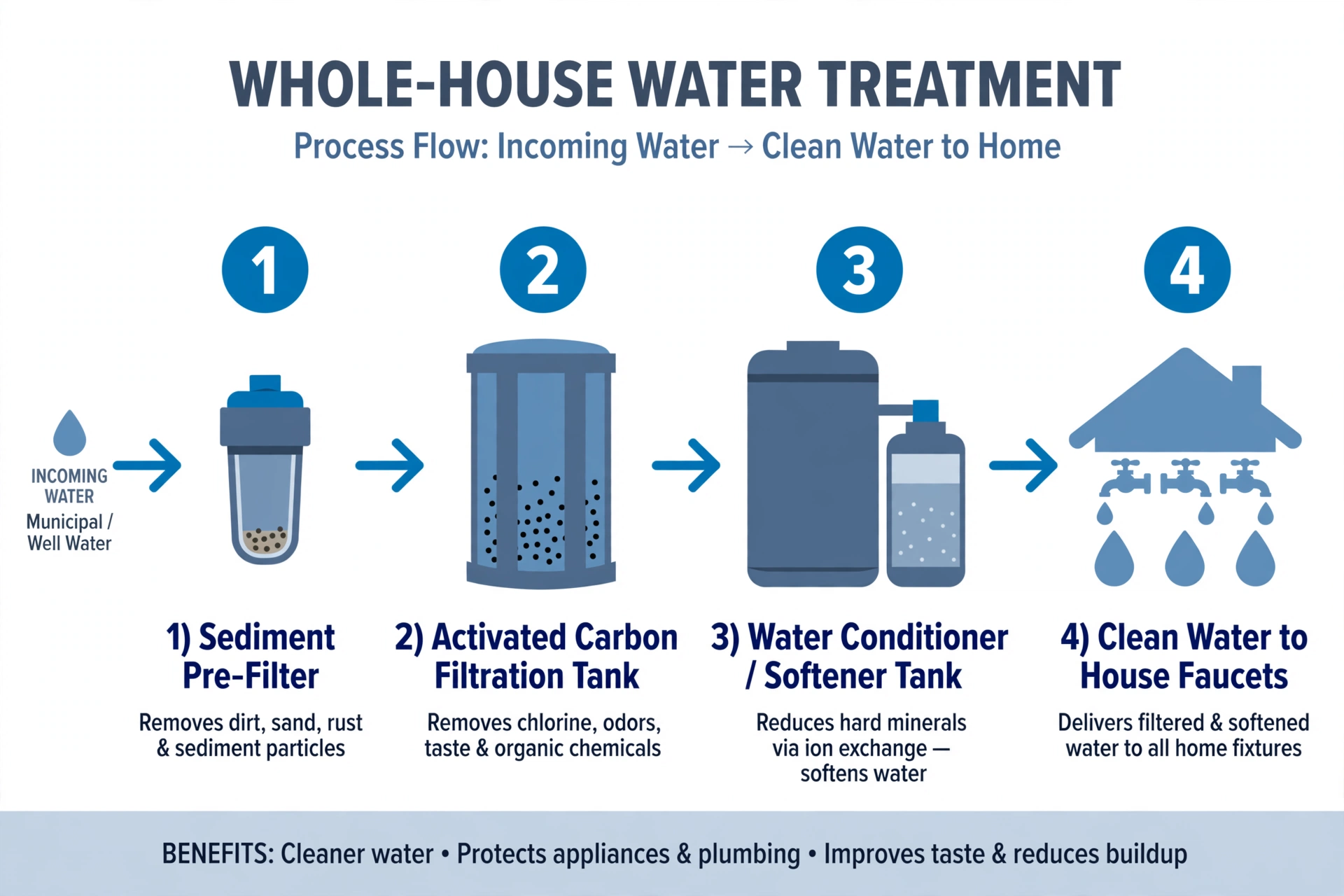
How to choose: the 5-minute buying guide
1. City water or well water? City water means a carbon/KDF tank system (picks 1–3). Well water means a lab test first, then iron/sulfur-specific equipment (pick 4 territory). This one decision eliminates half the market.
2. Size your flow rate. Add up what might run at once: a shower is ~2.5 GPM, a dishwasher ~2, laundry ~3. A 9 GPM system comfortably serves a 1–3 bathroom home. Go bigger if you regularly run multiple showers plus appliances. Undersizing is the #1 regret in buyer reviews. Low flow feels like a pressure problem, and it’s miserable to live with.
3. Read the certifications, not the adjectives. “Reduces contaminants!” means nothing. NSF/ANSI 42 (aesthetic: chlorine, taste/odor), 53 (health: lead, cysts, VOCs), and 61 (materials safety) are the standards that count, and they should name the specific standard and the contaminant. Then ask whether the certification covers the finished system or just components. Aquasana’s chlorine-reduction test and tank certification are system-relevant; Kind’s NSF/ANSI 42/61/372 listings are, per third-party analysis, component-level.
4. Price the maintenance, not just the unit. A $1,998 system at $120/year in filters costs nearly twice as much over a decade as a $1,144 system at $40/year. Always ask three questions: what do I replace, how often, and what does it cost?
5. Budget for installation. These are point-of-entry systems plumbed into your main line. A straightforward install typically runs a few hundred dollars ($200–$500 in many markets). Complex jobs (tight crawl spaces, rerouted plumbing) cost far more, so get an itemized quote. Handy homeowners DIY; everyone else hires a plumber. It’s a one-time cost. Don’t let it push you toward an undersized system.
Frequently asked questions
Do whole house filters reduce water pressure?
A correctly sized system shouldn’t cause a noticeable drop. Most are engineered for it, and long-term owners report pressure holding steady years in. An undersized system absolutely will reduce pressure. When in doubt, size up.
How long does installation take?
A plumber typically needs 2–4 hours for a standard install near the main shutoff. DIY is possible if you’re comfortable cutting into your main line and your local code allows it.
Will a whole house filter make my water safe to drink?
It depends on what’s in it. These systems reduce chlorine, taste, odor, and many chemicals under their stated certifications. They are not a blanket guarantee of safety. Bacteria, nitrates, arsenic, or lead concerns need testing and possibly targeted treatment (UV, reverse osmosis). Test first, treat second.
Salt-based softener vs. salt-free conditioner?
Softeners (ion exchange) actually remove hardness minerals. That’s the only thing that produces truly soft water. Salt-free conditioners (TAC) prevent scale buildup without removing the minerals; total dissolved solids stay unchanged. Different problems, different equipment. “Salt-free softener” is marketing language. Read it carefully.
How often do I really replace the main media?
For million-gallon tank systems, most households are looking at 6–10 years. The annual cost is the sediment pre-filters, not the tank. For cartridge systems like the Kind, follow the manufacturer’s swap schedule (6–12 months). Skipping it is the fastest way to waste your money.
The bottom line
For most city-water homes, the SpringWell CF1 is the pick: best long-term value, lowest maintenance, lifetime warranty, real chloramine capability. The honest caveat is that its performance evidence is manufacturer-published lab testing rather than a system-level NSF badge. If certifications and brand familiarity matter more, the Aquasana Rhino EQ-1000 is a strong second with the best add-on ecosystem. Just know the $1,998 post-sale price makes it a premium buy, not a value one. Hard water too? The Kind E-3000 combines filtration and salt-free scale conditioning in one compact box at ~$1,885. On a well? Stop shopping and get a lab test. The right system depends on your numbers.