
Disclosure: We may earn a commission if you buy through our links. Full disclosure
All prices were observed on 2026-09-30 and change often, always check the live price on the linked page before buying.
Under $1,000 buys a cartridge filter, not a treatment plant. Every system here is honest, useful equipment — and none of them does what a $2,000–$4,000 carbon tank or softener combo does:
| This tier handles | This tier does not |
|---|---|
| Chlorine taste and odor | Hardness minerals |
| Sediment | Iron and sulfur |
| General water feel on city water | PFAS |
If your problem is in the right column, a sub-$1,000 cartridge system is the wrong answer no matter which brand name is on the box. If your budget stretches past $1,000, our best whole-house water filters roundup compares the full-size systems.
What the sticker price hides: Our 10-year numbers put these five systems between roughly $800 and $3,000, the $99 GE runs you $1,399–$1,580 over a decade, while the $420 iSpring runs $1,860–$3,411. Buy the system whose filters you can afford, not just the box.
Before anything else: test first, treat second. You need to know whether your complaint is chlorine (taste/odor, a carbon filter fixes it), hardness (scale, spots, a filter does almost nothing), or something else entirely. Our testing guide covers the options. New to all of this? Start with Water Treatment 101 or take the Find Your System quiz.
Find your system
Know your water. Buy the right treatment. Answer a few questions about your water source and symptoms, and we narrow 49 systems down to your shortlist.
Short answer
- Under $1,000 buys chlorine/sediment filtration — not hardness, iron, or PFAS removal.
- Maximum filtration per dollar → iSpring WGB32B (~$420).
- Certified performance, lowest entry price → GE GXWH60T.
- Zero filter cost → Whirlpool WHELJ1, if you can find one in stock.
Our picks at a glance
- Best value multi-stage system: iSpring WGB32B, three-stage Big Blue, 15 GPM, ~$420, no independent certification
- Best budget pick: GE GXWH60T, $99 housing with a live NSF 42 + 372 listing; watch the 4.0 GPM rated flow and filter-sold-separately catch
- Best budget alternative: Whirlpool WHELJ1, self-cleaning, zero filter cost, also NSF 42 + 372; availability looks shaky as of our check
- Best ultra-budget carbon filter: APEC CB1-CAB20-BB, ~$150 single-stage carbon, the cheapest way into real whole-house filtration
- Best for simple sediment reduction (premium build): 3M Aqua-Pure AP902, 100,000-gallon stainless-head system; the “NSF 42” claim doesn’t survive a look at the certification directory
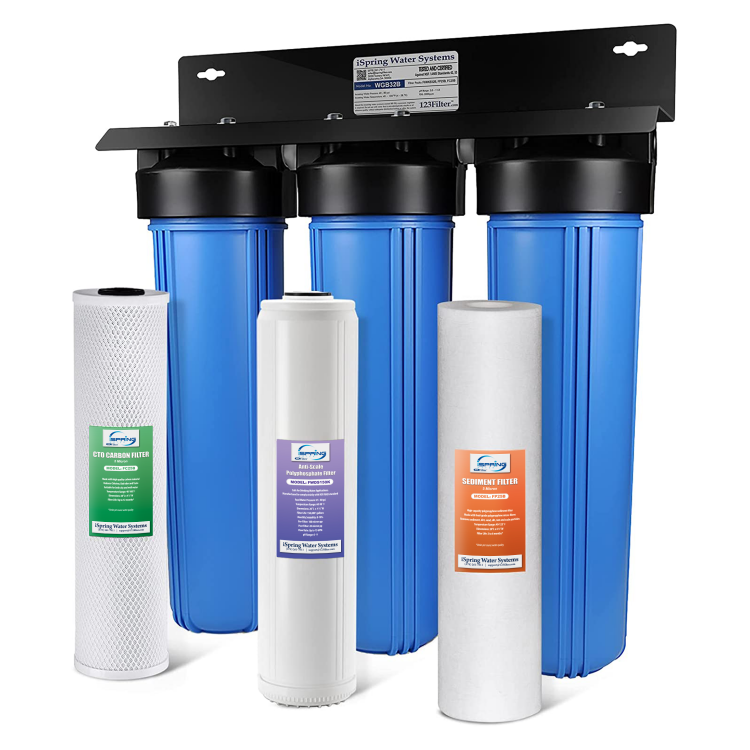
1. iSpring WGB32B, Best value multi-stage system under $1,000
Price: $419.99–$440.99 (Home Depot/Zoro, price observed 2026-09-30), Check current price Flow rate: 15 GPM Design: Three 20″ × 4.5″ Big Blue housings, 5-micron sediment pre-filter, then two coconut-shell CTO carbon blocks; 1″ NPT ports Capacity: Up to 100,000 gallons / ~1 year per cartridge set, per iSpring Replacement cost: F6WGB32B set ~$113.50 (iSpring sells 2 sets for $226.99); 1–2 sets per year → $114–$227/year Warranty: 1-year limited, per the Amazon listing Certification: None, no NSF, WQA, or IAPMO listing. iSpring’s page says the filters are “tested by an independent third-party to meet NSF/ANSI standards,” which names no lab and is not a certification. 10-year cost of ownership: $1,860–$3,411 ($186–$341/yr) (install $300–$700 estimated, plus filters)
Verdict: The most filtration you can buy for ~$420, a genuine three-stage Big Blue stack with real flow headroom. The trade is that nothing about its performance is independently certified; you’re taking iSpring’s word for the chlorine-reduction claims.
The WGB32B is the default answer for a city-water homeowner whose complaint is chlorine taste and odor plus sediment. Its most common cross-shop is the Aquasana Rhino — over this page’s budget, but we ran the comparison in our iSpring WGB32B vs Aquasana Rhino head-to-head. Three standard 20″ × 4.5″ housings mean replacement cartridges are commodity-priced and available from many brands, not just iSpring, that’s the practical advantage of Big Blue format. At 15 GPM it won’t starve a normal-size home the way budget single-cartridge housings can.
WGB32B trade-offs: there is no independent certification record for this system anywhere in the NSF, WQA, or IAPMO directories, iSpring is the only system on this page asking you to accept “tested to meet NSF/ANSI standards” from an unnamed lab. Its sibling, the WGB32B-PB, goes further and markets lead reduction without an NSF 53 listing, which tells you how the brand treats the line between testing and certifying. Three housings also mean three sets of O-rings and three potential leak points, and you should budget for a plumber if you’re not comfortable cutting into the main line. Chloramine, hardness, iron, and PFAS are outside what this system claims.
Buy it if: you’re on chlorinated city water, want maximum filtration per dollar, and are comfortable with manufacturer claims that aren’t independently certified. Skip it if: certification matters to you (the GE below is certified and costs less up front), or you need chloramine, hardness, or PFAS treatment.
2. GE GXWH60T, Best budget pick
Price: $99.00–$129.99 (Home Depot $99, price observed 2026-09-30); filter sold separately, Check current price Flow rate: 4.0 GPM rated (15.0 GPM max), 1″ NPT Design: Single-cartridge housing; takes GE FXWPT basic filters (or FXHTC advanced / FXHSC basic), replace every 3 months per GE Replacement cost: FXWPT $29.99 every 3 months → ~$119.96/year; the NSF-rated service cycle is 15,000 gallons Warranty: Not published, we couldn’t locate warranty terms for this model Certification: NSF/ANSI 42 certified (chlorine reduction; taste and odor reduction) and NSF/ANSI/CAN 372 (lead-free plumbing), per the live NSF listing for “GE Appliances, a Haier Company, GXWH60T / FXWPX”; also conforms to NSF/ANSI/CAN 61. One of only two systems in our 49-system certification database with a verifiable live listing at this price. 10-year cost of ownership: $1,399–$1,580 ($140–$158/yr) (install $100–$250 estimated, plus filters)
Verdict: The cheapest certified filtration in whole-house water, a $99 housing with a real NSF 42 + 372 listing. But “budget” here means a 4.0 GPM rated flow and a filter you replace four times a year; the 10-year math is what decides whether it’s actually cheap.
This is the pick for the buyer whose top priority is verified performance at the lowest entry price. The NSF listing is the whole argument: chlorine reduction and taste-and-odor reduction, independently tested at a 4.0 GPM rated flow over a 15,000-gallon service cycle, plus NSF 372 lead-free compliance. No other sub-$150 system in our database has both.
GXWH60T trade-offs: 4.0 GPM is the headline warning. A shower runs ~2.5 GPM and a washing machine ~3, run both together and you’re past the flow the certification was tested at. For a one-bathroom home with modest demand it’s fine; for a busy family home it’s undersized, and that will feel like a pressure problem. Second, the filter isn’t included in the box, and GE’s schedule is every 3 months, that’s four purchases a year, every year, which is how a $99 housing becomes a $1,400–$1,580 decade. Third, 15,000 gallons goes fast: a household using 300 gallons a day hits that in 50 days, so heavy users should treat the 3-month schedule as a minimum, not a target. And we could not find published warranty terms.
Buy it if: your home is small-to-medium, your complaint is chlorine taste/odor on city water, and you want independently certified performance for the lowest upfront price. Skip it if: your household regularly runs multiple fixtures at once (4.0 GPM rated flow), or a quarterly filter chore sounds miserable, the Whirlpool below has zero filter cost.
3. Whirlpool WHELJ1, Best budget alternative
Price: $297–$579 (last documented prices, see availability note below), Check current price Flow rate: 6.0 GPM service (9.6 GPM high-flow valve) Design: Self-cleaning whole-house filter with FilterSense technology; auto-flushes every 14 days to a drain line, no replacement cartridges Replacement cost: $0/year, there are no filters to buy Warranty: 1 year parts/labor, 5 years on the tank Certification: NSF/ANSI 42 certified (chlorine reduction; taste and odor reduction) and NSF/ANSI Std 372 compliant, per the live NSF listing for Water Channel Partners, WHELJ1, point-of-entry, 6 GPM; also conforms to NSF/ANSI/CAN 61. 10-year cost of ownership: $497–$1,079 ($50–$108/yr) (install $200–$500 estimated, needs a drain line and 24V AC power; zero media cost after that)
⚠️ Availability warning, read before you click. When we checked on 2026-09-30, we could not find a current US retail listing for the WHELJ1: it appears discontinued at Lowe’s and absent from Amazon and Whirlpool.com US retail. The prices above are the last documented figures, not a live quote. Verify it’s actually purchasable before planning around it.
Verdict: If you can still find one, it’s the lowest-maintenance certified option in this guide, a self-cleaning filter with NSF 42 + 372 credentials and a 10-year cost that can dip under $500. The “if” is doing heavy lifting.
The WHELJ1’s pitch is simple: it flushes itself. Every 14 days it backwashes trapped sediment and chlorine-loaded media to a drain, so the $0/year filter cost is real, and it’s why this system’s 10-year cost of ownership is the lowest of the five despite a higher sticker price. At 6.0 GPM service flow it also out-breathes the GE, and the certification story is equally solid.
WHELJ1 trade-offs: availability is the big one, a great deal on a discontinued product isn’t a deal. Beyond that, it needs a drain line and a 24V outlet near the install point, which adds install cost and rules out some locations; the periodic backwash uses water; and 6.0 GPM is still modest for a large home with simultaneous showers and laundry. It’s also a sediment/chlorine device, no hardness, iron, or PFAS claims.
Buy it if: you can confirm a live listing, hate buying replacement filters, and have a drain and outlet at the install point. Skip it if: it’s out of stock everywhere (likely), your home needs more than ~6 GPM, or you have no convenient drain.
4. APEC CB1-CAB20-BB, Best ultra-budget carbon filter
Price: $146.99–$152.99 (Home Depot $152.99, out of stock when checked; lwswater.com $146.99, price observed 2026-09-30), Check current price Flow rate: Cartridge-rated ~4 GPM Design: Single-stage 20″ Big Blue housing with granular activated carbon (GAC); rated up to 100,000 gallons per Home Depot’s listing; “effectively removes contaminants as small as 25 microns” per the retailer spec Replacement cost: FI-CAB20-BB cartridge ~$76 estimated → $70–$90/year (~11 months at 300 gal/day) Warranty: Not found, we couldn’t locate published warranty terms Certification: None. Note: APEC’s WQA Gold Seal certification is NSF 58 on its under-sink RO line, it does not cover this whole-house system. 10-year cost of ownership: $1,147–$2,053 ($115–$205/yr) (install $300–$1,000 estimated pro install; commonly DIY’d)
Verdict: The cheapest way to put real carbon filtration on your whole house. One stage, no certifications, but a ~$150 box with ~$80/year upkeep, the lowest annual maintenance cost of any cartridge system here.
This is the entry ticket: a single 20″ Big Blue housing filled with granular activated carbon, aimed squarely at chlorine taste and odor on city water. The Big Blue format is the quiet advantage, standard 20″ × 4.5″ cartridges fit, so you’re not locked into APEC’s replacements. Annual filter spend is the lowest of the cartridge picks.
APEC trade-offs: single-stage means single-job, chlorine taste/odor and some organics, nothing more. No independent certification of any kind, and the 4 GPM cartridge rating puts it in the same undersizing conversation as the GE. Home Depot showed it out of stock at our check, and we couldn’t find warranty terms. For ~$270 more, the iSpring adds sediment pre-filtration, a second carbon stage, and nearly 4× the flow rating.
Buy it if: your only complaint is chlorine taste/odor on city water, your budget is absolute, and you’re comfortable doing (or hiring) a simple install. Skip it if: you have sediment issues (no pre-filter), high flow demand, or want any independent certification.
5. 3M Aqua-Pure AP902, Best for simple sediment reduction (premium build)
Price: $328.42–$369.95 (Amazon $369.95 one-time, $351.45 with Subscribe & Save, price observed 2026-09-30), Check current price Flow rate: 10 GPM (20 GPM intermittent peak), 1″ ports Design: Sanitary Quick Change (SQC) single-cartridge system, 304 stainless-steel head, 5-micron nominal rating, 100,000-gallon capacity, 12-month cartridge life Replacement cost: AP910R cartridge yearly → $185.37–$234.94/year Warranty: 10 years on the system, 25 years on the head Certification: None found. Amazon’s listing bullet says “NSF STANDARD 42 CERTIFIED”, but the manufacturer description on the same page ends with the footnote “* Tested and verified by manufacturer’s laboratory.” A manufacturer-lab test is not an independent certification, and we found no live NSF, WQA, or IAPMO listing for the AP902. 10-year cost of ownership: $2,332–$3,019 ($233–$302/yr), the highest of the five
Verdict: A premium stainless-steel, high-flow housing for simple sediment/particulate reduction, with the best warranty here and the highest 10-year cost. Read the NSF claim the way the footnote asks you to: it’s a retailer claim resting on manufacturer-lab testing, not an independent certification.
The AP902 is the “buy it once” build: a corrosion-resistant 304 stainless head with a quarter-turn sanitary cartridge change, no filter wrench, no touching the media. At 10 GPM with a 20 GPM intermittent peak it handles large homes better than anything else in this guide, and the 100,000-gallon / 12-month cartridge is genuinely long-lived.
3M AP902 trade-offs: the “NSF STANDARD 42 CERTIFIED” bullet on the Amazon listing does not survive a check of the certification directories, and the footnote quietly downgrades the claim to manufacturer-lab testing. Second, the manufacturer’s own comparison table marks the AP902’s chlorine taste-and-odor reduction as “no data”, this is a sediment/particulate system with carbon media, and if chlorine is your main complaint, 3M’s own table points you to the AP903/AP904 siblings instead. Third, the economics: ~$210/year in cartridges gives this system the highest 10-year cost in the guide, and the stainless head is a premium you’re paying for whether or not your install needs it.
Buy it if: your main problem is sediment/particulates, you want high flow and a tool-free cartridge change, and the 25-year head warranty appeals to you. Skip it if: chlorine taste/odor is the target (the manufacturer itself doesn’t claim it for this model), the ~$210/year cartridge bill stings, or you want certified performance, the GE and Whirlpool are certified for less.
At a glance: the five picks compared
| iSpring WGB32B | GE GXWH60T | Whirlpool WHELJ1 | APEC CB1-CAB20-BB | 3M Aqua-Pure AP902 | |
|---|---|---|---|---|---|
| Best for | Maximum filtration per dollar | Certified performance, lowest entry price | Zero filter cost, self-cleaning | Absolute lowest budget | Sediment reduction, premium build |
| Price (2026-09-30) | $419.99–$440.99 | $99.00–$129.99* | $297–$579† | $146.99–$152.99 | $328.42–$369.95 |
| Flow rate (rated) | 15 GPM | 4.0 GPM | 6.0 GPM | ~4 GPM | 10 GPM |
| Stages / design | 3-stage Big Blue | Single cartridge | Self-cleaning tank | Single-stage Big Blue | Single SQC cartridge |
| Chlorine taste/odor | Yes (manufacturer claim) | Yes (NSF 42 certified) | Yes (NSF 42 certified) | Yes (manufacturer claim) | Not claimed by 3M |
| Hardness / iron / PFAS | No | No | No | No | No |
| Independent certification | None | NSF 42 + 372 | NSF 42 + 372 | None | None found |
| Annual filter cost | $114–$227 | $119.96 | $0 | $70–$90 | $185–$235 |
| 10-year cost of ownership | $1,860–$3,411 | $1,399–$1,580 | $497–$1,079 | $1,147–$2,053 | $2,332–$3,019 |
| Annualized cost | $186–$341/yr | $140–$158/yr | $50–$108/yr | $115–$205/yr | $233–$302/yr |
| Warranty | 1-yr limited | Not published | 1 yr parts/labor, 5 yrs tank | Not found | 10 yrs system / 25 yrs head |
*Filter sold separately. †Last documented prices, current availability unconfirmed (see WHELJ1 section). All prices observed 2026-09-30; verify at purchase.
How to choose: the 5-minute budget buying guide
1. Test first, treat second, and know when you don’t need a filter at all. If your water tastes fine, doesn’t smell, and leaves no sediment, you don’t have a filtration problem, save your money. If your complaint is white scale on fixtures, that’s hardness, and no cartridge filter in this guide fixes it (you need a softener or conditioner). If it’s orange staining or a rotten-egg smell on well water, that’s iron or sulfur, again, the wrong equipment. A filter you don’t need is the most expensive kind. Our testing guide walks through confirming what you actually have.
2. Buy for what the budget tier actually does. Under $1,000 buys carbon and sediment filtration: chlorine taste and odor (all five, minus the 3M caveat above), particulates, and generally better-tasting water throughout the house. It does not buy hardness removal, iron/sulfur treatment, or PFAS reduction, those need different media and bigger budgets. Buy for the problem you have, not the features on the box.
3. Size your flow rate, the most common budget regret. A shower runs ~2.5 GPM, a dishwasher ~2, laundry ~3. The GE’s 4.0 GPM rated flow is the cautionary tale: it’s fine for a small home with sequential water use, but run a shower and a washing machine together and you’re past the flow the system was certified at, which reads as a pressure problem you’ll blame on your plumbing. When in doubt, size up: the iSpring (15 GPM) and 3M (10 GPM) exist precisely for this reason. Check your home’s peak demand before buying anything rated under 6 GPM.
4. Price the ownership, not the box. Our cost-of-ownership database puts 10-year totals for these five between ~$500 and ~$3,400. The pattern: cheap housings with quarterly filters (GE: $99 box, $120/year in filters) can cost more over a decade than a pricier self-cleaning system (Whirlpool: ~$400 box, $0/year). Ask “what do the filters cost per year?” before “what does the box cost?”
5. Check the certification directory yourself. “NSF certified” is a claim you can verify in 60 seconds at NSF’s drinking-water directory, and the 3M AP902 is your reminder of why. Manufacturer phrases like “tested to meet NSF/ANSI standards” or footnotes reading “tested and verified by manufacturer’s laboratory” are not certifications, and they’re not equivalent to one. Our certification database tracks which of 49 systems hold live listings.
Frequently asked questions
Can a whole-house filter under $1,000 remove PFAS? No, not reliably. PFAS reduction needs purpose-built media (or reverse osmosis at the drinking-water tap) with NSF/ANSI 53 or P473 certification for the specific compounds. None of the systems in this guide carry those certifications or make those claims. If PFAS is your concern, it’s a different budget and different equipment.
Will any of these fix hard water? No. Carbon and sediment filters do essentially nothing for hardness minerals. Hardness needs a salt-based softener (ion exchange) or a salt-free conditioner, both well above this price tier. If scale is your problem, a $500 filter is money spent on the wrong tool.
What about iron or sulfur smell on well water? Also outside this tier. Iron and hydrogen sulfide need oxidation/filtration or dedicated iron filters sized to your levels, get a lab test first, because the treatment depends on concentration and pH. A carbon cartridge will not fix orange staining or rotten-egg odor.
Does NSF 42 certification mean the water is safer? NSF/ANSI 42 covers aesthetic effects, chlorine taste and odor, particulates. It’s about how water tastes, smells, and looks, not health claims. Health-effect claims live under NSF/ANSI 53 (and others), which none of these systems hold. Certified-to-42 is still meaningful, it means an independent lab verified the taste/odor claims, but don’t read “safer” into it.
What’s the difference between rated flow and maximum flow? Rated flow is the flow the system’s performance claims were tested at (e.g., the GE’s 4.0 GPM). Maximum flow is what the housing can physically pass (the GE’s 15.0 GPM). Performance above the rated flow is untested, treat rated flow as the real number when sizing.
How hard is installation? Budget a plumber unless you’re comfortable cutting into the main water line. Rough planning estimates: $100–$250 for a simple single-housing swap-in (GE), $300–$700+ for multi-housing Big Blue installs (iSpring, APEC), $200–$500 for the Whirlpool (drain line + power outlet needed), $150–$300 for the 3M. Get a quote, install cost is the swing factor in every system’s 10-year math.
Buying in this tier
Under $1,000, you’re buying chlorine taste-and-odor and sediment filtration, and the honest picks are the ones that say so. For maximum filtration per dollar, the iSpring WGB32B (~$420) is the value play, with the caveat that none of its claims are independently certified. For certified performance at the lowest entry price, the GE GXWH60T ($99 + filters) carries a real NSF 42 + 372 listing, just respect the 4.0 GPM rated flow and the quarterly filter bill. For zero filter cost, the Whirlpool WHELJ1 is the best deal in the guide if you can find one in stock, verify availability before anything else. For the absolute lowest budget, the APEC CB1-CAB20-BB (~$150) gets carbon on your whole house for ~$80/year in upkeep. And the 3M Aqua-Pure AP902 is the premium stainless build for simple sediment reduction at high flow, buy it for the hardware and the warranty, not for the “NSF 42” bullet on the listing, which doesn’t check out. Whatever you pick, buy the filters you can afford, not just the box: the cheapest system to buy is rarely the cheapest to own.
How we evaluate: We don’t own a test lab, so we won’t pretend we installed five systems in one house. Our picks are drawn from our own research databases of 50 whole-house systems, tracking certification records, flow rates, and real cost of ownership, plus manufacturer-published specs and warranty terms. For every performance claim, we say whose it is: the manufacturer’s, a certification body’s, or ours. “Certified to NSF 42” means an independent body verified it; “tested to meet NSF/ANSI standards” is manufacturer language for unnamed-lab testing, and we treat those two things very differently.
Compare the data
All 49 systems side by side. Filter by price, flow rate, certifications, and estimated 10-year ownership cost.
Check current prices: iSpring WGB32B · GE GXWH60T · Whirlpool WHELJ1 · APEC CB1 · 3M AP902 — prices change often, verify live before buying.
What to do next
- Test your water — get a lab test before buying anything: how to test your water.
- Identify the treatment — match your test results to the right equipment: Water Treatment 101.
- Compare systems — filter 49 whole-house systems by your problem, flow, and budget: System Finder.
- Calculate 10-year cost — the sticker price is the cheapest part of owning a system: cost guide.
- Find your system — answer four questions and get your shortlist: Find Your System quiz.
Sources & Verification
Every performance claim in this guide traces to one of three places: the manufacturer’s own published specs, a live certification-body listing, or our own cost-of-ownership math. We checked the following on 2026-09-30.
GE GXWH60T’s certification record. NSF’s drinking-water listings show “GE Appliances, a Haier Company, GXWH60T / FXWPX, 15,000-gallon service cycle, 4 GPM, Chlorine Reduction, Taste and Odor Reduction,” marked certified to NSF/ANSI/CAN 372 and conforming to NSF/ANSI/CAN 61 (health effects). (NSF International, NSF/ANSI 42 point-of-entry listings, the GXWH60T entry; find it via the page’s company filter.)
Whirlpool WHELJ1’s certification record. NSF’s listings for Water Channel Partners show “Whirlpool WHELJ1, point-of-entry, 570,000-gallon service cycle, 6 GPM, Chlorine Reduction, Taste and Odor Reduction,” marked as complying with NSF/ANSI Std 372 and conforming to NSF/ANSI/CAN 61. (NSF International, NSF/ANSI 42 listings, Water Channel Partners)
How to verify any “NSF certified” claim yourself. NSF’s public directory lets you search by brand, model, standard, and product type, the fastest way to separate a real certification from marketing language. (NSF International, Drinking Water Treatment Units directory; the WQA product directory covers WQA Gold Seal listings.)
iSpring’s “tested to meet NSF/ANSI standards” language. iSpring’s own page for the F6WGB32B replacement set states the filters are “tested by an independent third-party to meet NSF/ANSI standards”, naming no lab, alongside the 100,000-gallon capacity and 15 GPM figures we cite. Two replacement sets list at $226.99, i.e., ~$113.50 per set. (iSpring, F6WGB32B replacement filter set) No NSF, WQA, or IAPMO listing exists for the WGB32B system in any of the three directories.
APEC CB1-CAB20-BB pricing and specs. Home Depot’s listing shows $152.99 (out of stock at our check), “up to 100,000 gal.” capacity, and “effectively removes contaminants as small as 25 microns.” (Home Depot, APEC CB1-CAB20-BB)
3M AP902’s NSF claim vs. the footnote. The Amazon listing’s “About this item” bullet claims “NSF STANDARD 42 CERTIFIED,” but the manufacturer description on the same page ends with “* Tested and verified by manufacturer’s laboratory”, and the listing’s own comparison table marks the AP902’s chlorine taste-and-odor reduction as “no data” (the AP903/AP904 siblings get the checkmark). We found no live NSF, WQA, or IAPMO listing for the AP902. (Amazon, 3M Aqua-Pure AP902 listing)
EPA on chlorine in drinking water. The EPA’s National Primary Drinking Water Regulations table sets a maximum residual disinfectant level (MRDL) of 4.0 mg/L for both chlorine and chloramine, the context for what “chlorine reduction” claims are actually about. (EPA, National Primary Drinking Water Regulations table)
Cost-of-ownership and certification data. The 10-year totals, annual filter costs, flow rates, and certification statuses cited above come from our own 49-system research databases, published September 2026: cost of ownership, certification, and the underlying spec records. Install-cost figures are our planning estimates based on observed market ranges, not quotes.
Independent review: We may earn a commission if you buy through our links. This review is based on manufacturer specifications, certification records, and published pricing — not hands-on testing.
As an Amazon Associate we earn from qualifying purchases.
By the Pure Whole House Team