
By the Pure Whole House Team
Disclosure: We may earn a commission if you buy through our links. Full disclosure
Find your system
Know your water. Buy the right treatment. Answer a few questions about your water source and symptoms, and we narrow 49 systems down to your shortlist.
Short answer
- Chlorine on your water report → iSpring WGB32B (value) or GE GXWH60T (certified budget).
- Chloramine → you need catalytic carbon: the Aquasana Rhino Chloramines Edition.
- Taste-only complaint at one tap → point-of-use, not whole-house.
Chlorine and chloramine are different problems, treat them that way
Most whole-house filters advertise “chlorine removal,” but if your water utility uses chloramine, a standard carbon filter may not do the job well. Why the distinction matters:
- Chlorine is a fast-acting disinfectant that standard activated carbon (including inexpensive carbon blocks) adsorbs well. Most city-water carbon filters handle it fine.
- Chloramine (formed when ammonia is added to chlorine) is a longer-lasting disinfectant used by more than 1 in 5 Americans’ water systems, according to the EPA, and it has been used since the 1930s. It is much harder for standard carbon to break down. Effective chloramine reduction requires catalytic carbon and longer contact time, which usually means a larger tank system, not a simple cartridge.
The EPA caps both disinfectants at a maximum residual disinfectant level (MRDL) of 4.0 mg/L (as Cl2), and tap water that meets federal standards is safe to drink. But “safe” is not the same as “pleasant”, the pool smell, the dry skin, the taste in your coffee. That gap is what these filters address. Buy the wrong media for your disinfectant and you’ve bought an expensive paperweight.
New to water treatment? Start here →
Test first, treat second
Before spending a dollar on a whole-house filter, find out which disinfectant your water actually contains. Check your utility’s annual water-quality report (the Consumer Confidence Report), which every community water system publishes, it lists the disinfectant used and the levels measured. This takes five minutes and determines everything that follows: chlorine = carbon block is enough; chloramine = you need catalytic carbon.
When you do NOT need a whole-house chlorine/chloramine filter:
- You’re on a private well. Well water is not treated by a utility, so it contains no chlorine or chloramine to remove. A carbon filter here only helps if you chlorinate your own well. (See our well-water guidance instead.)
- Your water tastes fine and the report shows low disinfectant levels. If you have no taste or odor complaints, a whole-house system may be overkill.
- Only your drinking water bothers you. If the tap tastes like a pool but the shower doesn’t bother you, a point-of-use filter, an under-sink system or a pitcher, costs a fraction of a whole-house install.
Picks at a glance
- Aquasana Rhino, Best for chloramine (catalytic-carbon model) and the best mainstream pick for chlorine
- iSpring WGB32B, Best value carbon-block system for chlorine on municipal water
- GE GXWH60T, Best budget pick, and one of two systems here with a live NSF/ANSI 42 certification
- Whirlpool WHELJ1, Best low-maintenance alternative, with self-cleaning media and a live NSF listing
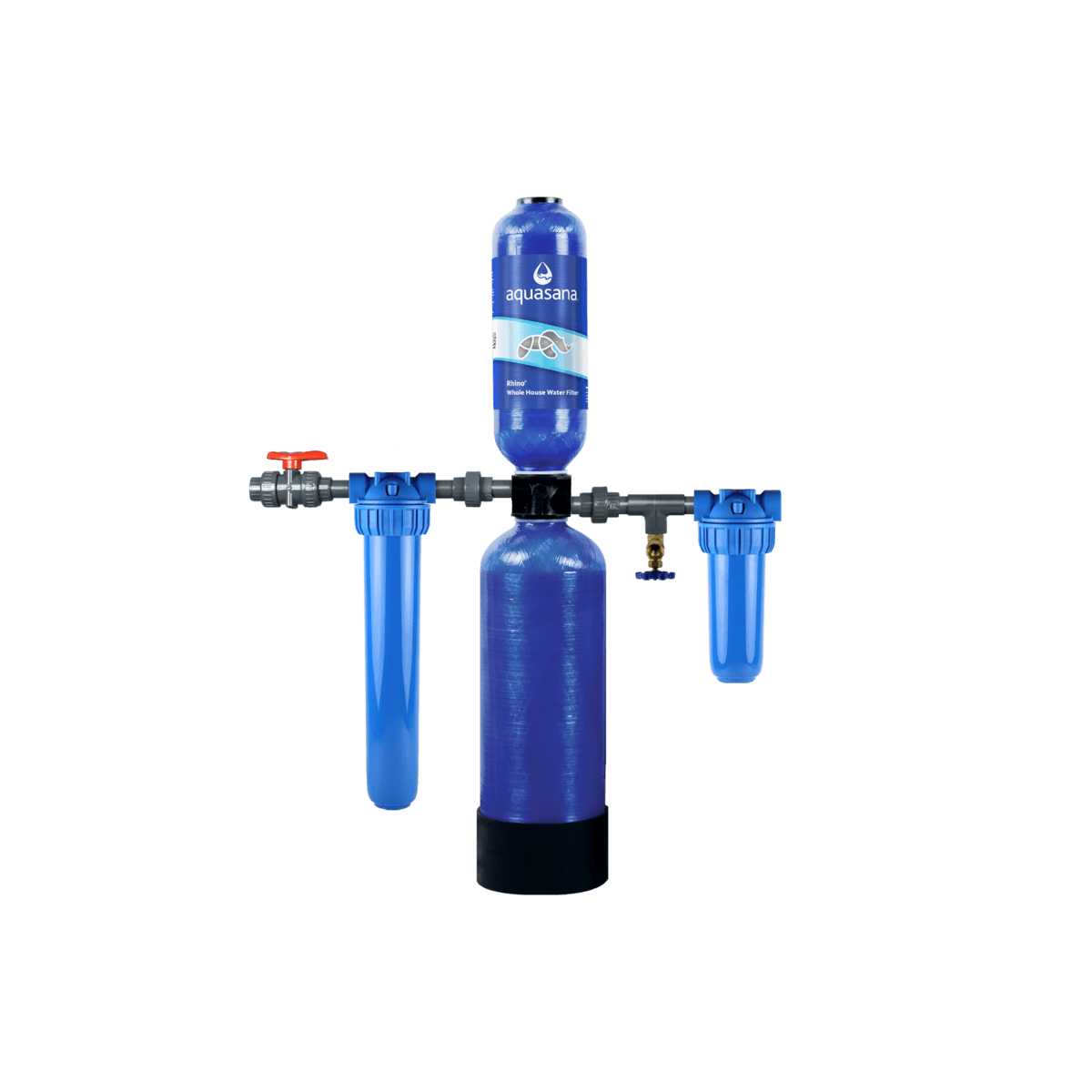
1. Aquasana Rhino, Best for chloramine
The Rhino comes in two distinct versions, and picking the right one is the whole point of this article.
For chloramine: Rhino Chloramines Edition (WH-1011)
Price observed 2026-09-30: Not captured in our latest pricing sweep, check current price
Rated flow: 7.0 GPM · Media: 100% catalytic carbon in both tanks · Capacity: 1,000,000 gallons / up to 10 years · Certification: tank WQA-certified to NSF/ANSI/CAN 61 (materials safety) and CSA B483.1 (structural integrity) only
Unlike the standard Rhino, the Chloramines Edition uses 100% catalytic carbon in both filter tanks, no KDF-55, no standard activated carbon. Aquasana states it was independently tested to reduce 83% of chloramine and 97% of chlorine for 1,000,000 gallons or up to 10 years. It is rated for 7.0 GPM, sized for homes up to 2.5 baths or 4 people.
Be precise about what “independently tested” means here: Aquasana’s own product page claims third-party testing, but we found no live NSF or WQA system-level listing for chloramine reduction on this model. The WQA certification covers the tank’s materials safety and structural integrity, explicitly not contaminant reductions. That is still more evidence than most competitors provide, but it is not certification.
Verdict: The most credible chloramine-specific option among mainstream whole-house filters, purpose-built catalytic carbon media, a specific tested reduction figure (83%), and a 10-year capacity rating. Not cheap, but chloramine is a problem that genuinely costs more to solve.
Buy it if: your water-quality report confirms chloramine (or your utility is considering switching to it) and you want filtration at every tap.
Skip it if: you’re on chlorine-only water, Check current price
For chlorine: Rhino EQ-1000
Price observed 2026-10-15: $1,998 (equipment; the $999 sale ended) · Install: $200–$500 · Annual maintenance: $100–$120 · 5-year cost of ownership: $2,698–$3,098 · 10-year cost of ownership: $3,198–$3,698 ($320–$370/yr) Per 1,000 gallons: ~$2.92–$3.38.
Rated flow: 7.0 GPM (peak flow 14.6 GPM per retailer listings) · Media: KDF-55 copper-zinc + coconut shell carbon, 5-micron pre-filter + 0.35-micron post-filter · Capacity: 1,000,000 gallons / 10 years · Warranty: 10 years
The standard EQ-1000 is Aquasana’s mainstream tank system: KDF-55 media plus coconut-shell carbon with very fine post-filtration, no backflushing, no cartridges to replace. Aquasana states it was independently tested to NSF/ANSI 42 to remove up to 97% of chlorine, again, tested to the standard, not certified to it; we found no live NSF listing. The tank itself is WQA-certified to NSF/ANSI/CAN 61 for materials safety and CSA B483.1 for structural integrity, not for contaminant reduction.
One caution from our research: Aquasana’s data sheet for the smaller EQ-600 sibling claims NSF/ANSI 42 certification, but we found no live NSF listing for it, the largest claim-vs-certification gap in our database. The EQ-1000’s wording is more careful (“independently tested to”), and we rate claims more highly when they’re worded precisely.
Verdict: A solid, long-lived chlorine tank system with fine post-filtration and a genuine 10-year warranty. You’re paying for longevity and low maintenance, not for certification.
Buy it if: you want a decade of chlorine filtration with no cartridges to replace and no backflush cycles to manage.
Skip it if: chloramine is your problem, Check current price
2. iSpring WGB32B, Best value carbon-block system
Price observed 2026-09-30: $419.99–$440.99 (equipment) · Install: $300–$700 · Annual maintenance: $114–$227 · 5-year cost of ownership: $1,290–$2,276 · 10-year cost of ownership: $1,860–$3,411 ($186–$341/yr)
Flow: 15 GPM peak (manufacturer manual rates 3–15 GPM) · Media: 5-micron polypropylene sediment (FP25B) + two CTO coconut-shell carbon blocks (FC25B) · Housing: 20″ × 4.5″ Big Blue, 1″ NPT ports · Capacity: 100,000 gallons / 12 months · Warranty: 1-year limited, 30-day money-back · Certification: none at system level ·
The WGB32B is the classic three-stage cartridge approach: a sediment pre-filter protects two high-capacity carbon blocks. It’s the system iSpring itself points municipal-water customers toward, the WGB32B-PB sibling with a lead-reducing stage exists for well water and heavy metals, while the base WGB32B targets the standard municipal contaminant set.
On the evidence chain: iSpring states its filters are “tested by an independent third-party to meet NSF/ANSI standards,” but names neither the standard nor the testing body, that is not a certification, and we treat it accordingly. More concretely, iSpring’s own product page states the WGB32B series removes up to 95% of sediment, chlorine, chloramines, and other contaminants, tested by SGS in 2018. That’s a manufacturer claim with a named lab and date, meaningful, but still a claim, and carbon blocks have less contact time than tank systems for chloramine.
Replacement economics are transparent: the F6WGB32B replacement set was observed at $226.99 for a two-set bundle (~$113.50 per annual set), with the $114–$227 annual range reflecting whether you replace once or twice a year.
Verdict: The best chlorine value in whole-house filtration, Big Blue carbon blocks, honest pricing, and a named third-party test behind the reduction claims. No certification, and not our first choice for confirmed chloramine.
Buy it if: you’re on municipal water with chlorine, want strong flow (15 GPM), and like the simplicity of cartridge swaps.
Skip it if: your report shows chloramine, contact time in cartridge systems is shorter than in catalytic-carbon tanks. Check current price on Amazon
3. GE GXWH60T, Best budget pick
Price observed 2026-09-30: $99–$129.99 (housing; filter sold separately) · Install: $100–$250 (estimated, not manufacturer-published) · Annual maintenance: ~$120 (FXWPT cartridge $29.99, replaced 4×/year) · 5-year cost of ownership: $799–$980 · 10-year cost of ownership: $1,399–$1,580 ($140–$158/yr)
Flow: rated 4.0 GPM (max 15.0) · Ports: 1″ NPT · Cartridge: FXWPT, 15,000 gallons / 3 months · Warranty: not located ·
Certification: This is the headline. The GXWH60T is one of only two systems in our 49-system certification database with a verifiable live system-level listing: NSF/ANSI 42 and NSF/ANSI 372, listed under GE Appliances with the FXWPX element, 15,000 gallons at 4 GPM for chlorine reduction plus taste-and-odor reduction, conforming to NSF/ANSI/CAN 61 for materials. It is also NSF/ANSI/CAN 372 certified for lead-free materials.
A nuance worth knowing: GE’s manual pairs the system with the FXWPT cartridge, which NSF lists as a component conforming to material requirements only, the performance listing names the FXWPX element. Home Depot lists the housing as compatible with either cartridge. If the certified performance matters to you, use the FXWPX.
The honest trade-off: 4.0 GPM rated flow is modest, fine for small households, tight for a house where two showers and the laundry run together. And at $29.99 per cartridge four times a year, the replacement habit costs more than the housing within the first year. Budget doesn’t mean cheapest forever.
Verdict: The only sub-$130 system here with a live NSF/ANSI 42 certification, a real, checkable performance claim, which is rare at this price. Modest flow and a quarterly cartridge habit are the costs.
Buy it if: you want certified chlorine reduction on a small budget and your household’s flow needs are modest.
Skip it if: you need high flow, hate quarterly maintenance, or have chloramine, a single 20″ cartridge isn’t the tool for that. Check current price on Amazon
4. Whirlpool WHELJ1, Best low-maintenance alternative
Last documented prices: $297–$579, we could not locate a current US retail price as of 2026-09-30; the system appears discontinued at Lowe’s and is absent from Amazon and Whirlpool’s US site, so treat availability as uncertain. · Annual maintenance: $0 (self-cleaning media, no cartridges) · 5-/10-year cost of ownership: $497–$1,079 ($50–$108/yr)
Flow: 6.0 GPM service (9.6 GPM high-flow valve), 10 psi pressure drop at service flow · Certification: NSF/ANSI 42 + 372 (verified live under Water Channel Partners), 570,000-gallon service cycle at 6 GPM for chlorine + taste/odor reduction · Warranty: 1 year parts/labor, 5 years on the tank ·
The WHELJ1 is the interesting engineering pick: a “FilterSense” self-cleaning media bed that backwashes automatically every 14 days (3.4 GPM during the flush), so there are no cartridges to buy and no annual maintenance cost, the only system here with $0/year upkeep. And it carries the second of our two live NSF/ANSI 42 system listings, with a 570,000-gallon service cycle.
The catch is availability. We could not verify a current US retail price on 2026-09-30, and the system appears to have been dropped by major retailers. It may still surface at plumbing suppliers or the used market, but we can’t recommend buying what we can’t confirm is sold. If you find it in stock at a documented price, the economics are excellent; if not, the iSpring or GE picks are the live alternatives.
Verdict: Certified performance with zero maintenance cost, the best ownership economics here, but availability is uncertain as of 2026-09-30. Verify it’s actually in stock before planning around it.
Buy it if: you can find it in stock and want certified chlorine reduction with no cartridge habit.
Skip it if: it’s unavailable at retail, don’t chase a discontinued system. Check availability on Amazon
Comparison table
| System | Best for | Equipment (observed 2026-09-30) | Flow | Media | Chlorine | Chloramine | Certification | 10-yr cost |
|---|---|---|---|---|---|---|---|---|
| Aquasana Rhino Chloramines (WH-1011) | Chloramine | Not captured, check current price | 7.0 GPM | 100% catalytic carbon | Yes (97% tested) | Yes (83% tested) | WQA 61 tank only (materials/structural) | — |
| Aquasana Rhino (EQ-1000) | Long-lived chlorine filtration | $1,998 | 7.0 GPM | KDF-55 + coconut carbon | Yes (97% tested) | No | “Tested to” NSF/ANSI 42; WQA 61 tank only | $3,198–$3,698 |
| iSpring WGB32B | Value carbon block | $419.99–$440.99 | 15 GPM | Sediment + 2× CTO carbon block | Yes (95% claimed, SGS) | Claimed, not our first choice | None (third-party “tested to” claim only) | $1,860–$3,411 |
| GE GXWH60T | Budget | $99–$129.99 | 4.0 GPM | FXWPT/FXWPX cartridge | Yes, NSF 42 certified | No | NSF/ANSI 42 + 372 (live listing) | $1,399–$1,580 |
| Whirlpool WHELJ1 | Low maintenance | $297–$579 (last documented; availability uncertain) | 6.0 GPM | Self-cleaning media bed | Yes, NSF 42 certified | No | NSF/ANSI 42 + 372 (live listing) | $497–$1,079 |
See the full records behind this table in our certification database (49 systems checked against live NSF and WQA listings).
How to choose: chlorine vs. chloramine, and what actually matters
- Confirm your disinfectant first. Your utility’s water-quality report says which one you have. Everything below follows from that answer.
- Chloramine demands catalytic carbon. Standard activated carbon breaks chloramine down slowly; catalytic carbon (as in the Rhino Chloramines Edition) is engineered for it. If your report says chloramine, cartridge carbon blocks are a compromise, not a solution.
- Contact time beats marketing. Carbon works by contact: bigger media beds and slower flow remove more. Tank systems (Rhino) give disinfectants minutes of contact; cartridges give seconds. For chlorine that’s fine; for chloramine it matters.
- Size the flow to your house. Count fixtures that run together: a 4.0 GPM system (GE) suits a small household; 6–7 GPM (Whirlpool, Rhino) suits typical family homes; 15 GPM (iSpring) covers large homes with multiple simultaneous showers. Undersize the flow and you’ll feel it as weak showers.
- Weigh certification against claims. In our 49-system certification database, only the GE and Whirlpool systems had live, system-level NSF/ANSI 42 listings. “Independently tested to” (Aquasana) and “tested to meet NSF/ANSI standards” (iSpring) are weaker claims, note the exact wording.
- Compare the decade column, not the price tag. The GE housing was observed at $99 up front (2026-09-30) with ~$120/year in cartridges; the Whirlpool costs more up front and $0/year after. Our 10-year cost column exists for exactly this comparison.
- Plan the install. Whole-house systems sit on your main water line, most homeowners hire a plumber ($200–$500 typical for tank systems). Budget it alongside the equipment.
Frequently asked questions
Will a standard carbon filter remove chloramine?
Partially and slowly. Standard activated carbon (including carbon blocks) breaks chloramine down much less efficiently than it does chlorine, and the short contact time in cartridge systems makes it worse. For reliable chloramine reduction you want catalytic carbon in a tank system, like the Rhino Chloramines Edition. iSpring claims up to 95% chloramine reduction for the WGB32B series (SGS-tested, 2018), but that’s a manufacturer claim, not a certification.
Do I need a whole-house filter if only my drinking water tastes like chlorine?
Probably not. If the shower doesn’t bother you, a point-of-use filter costs far less. Epic Water Filters (a company we have an affiliate relationship with) makes under-sink and pitcher systems for exactly this case, see their drinking-water options.
Is chloramine in tap water safe?
Tap water that meets EPA standards is safe: the EPA sets a maximum residual disinfectant level of 4.0 mg/L for both chlorine and chloramine. A filter addresses taste, odor, and dryness, not a safety problem.
How do I know if my city uses chlorine or chloramine?
Check your water utility’s annual water-quality report (Consumer Confidence Report), it lists the disinfectant and measured levels. You can also call the utility directly. More than 1 in 5 Americans receive chloraminated water, per the EPA, so it’s worth checking rather than assuming.
What’s the real difference between “tested to” and “certified to” NSF/ANSI 42?
“Certified to” means an accredited body (NSF, WQA) tested the system and lists it publicly, you can verify it yourself in the WQA directory or NSF’s listings. “Tested to” means the manufacturer says a lab tested against the standard, but no independent body stands behind the claim and there’s no public listing to check. We found live system-level NSF/ANSI 42 listings for only the GE GXWH60T and Whirlpool WHELJ1 among 49 systems.
Pick from your water report
Start with your water report. If it says chlorine, the iSpring WGB32B gives you the best value in high-flow carbon-block filtration, and the GE GXWH60T gives you certified performance for under $130 if your flow needs are modest. If it says chloramine, stop comparing carbon blocks and get catalytic carbon, the Aquasana Rhino Chloramines Edition is the mainstream pick built for exactly that. And if you find a Whirlpool WHELJ1 in stock, its certified performance with zero maintenance cost is the best ownership math on this page.
How we evaluate: For each system below we record the manufacturer’s claims (flow rate, capacity, contaminant reduction), then check those claims against live certification records from NSF and WQA, and against published pricing to compute a 5- and 10-year cost of ownership. Where a manufacturer claim has no certification record behind it, we say so plainly. Hands-on tested: No, we are an independent research publication, not a testing lab.
Compare the data
All 49 systems side by side. Filter by price, flow rate, certifications, and estimated 10-year ownership cost.
Check current prices: Aquasana Rhino · Aquasana Rhino Chloramines · iSpring WGB32B · GE GXWH60T · Whirlpool WHELJ1 — prices change often, verify live before buying.
What to do next
- Test your water — get a lab test before buying anything: how to test your water.
- Identify the treatment — match your test results to the right equipment: Water Treatment 101.
- Compare systems — filter 49 whole-house systems by your problem, flow, and budget: System Finder.
- Calculate 10-year cost — the sticker price is the cheapest part of owning a system: cost guide.
- Find your system — answer four questions and get your shortlist: Find Your System quiz.
Sources & Verification
- NSF DWTU listings, GE GXWH60T (NSF/ANSI 42 + 372). Verified live 2026-09-30: listed under GE Appliances with FXWPX element, 15,000-gal capacity, 4 GPM, chlorine + taste/odor reduction. NSF listing
- NSF DWTU listings, Whirlpool WHELJ1 (NSF/ANSI 42 + 372). Verified live 2026-09-30: listed under Water Channel Partners (Ecodyne), 570,000-gal service cycle, 6 GPM. NSF listing
- WQA product directory. Checked 2026-09-30 for Aquasana tank certifications (NSF/ANSI/CAN 61 materials-safety + CSA B483.1 structural only, no contaminant-reduction certification). find.wqa.org
- Aquasana, Rhino Chloramines Whole House Water Filter. Product page confirms 100% catalytic carbon in both tanks, independently tested to reduce 83% chloramine and 97% chlorine for 1,000,000 gallons / up to 10 years, rated 7.0 GPM. Aquasana product page
- iSpring, WGB32B product page (via WGB32B-PB page). Confirms WGB32B is iSpring’s municipal-water system (5-micron sediment + CTO carbon block); states up to 95% sediment/chlorine/chloramine reduction, tested by SGS (2018). iSpring product page
- GE Appliances Parts, GXWH60T specifications. Confirms $129.99 housing price, FXWPT cartridge compatibility (filter not included), 3-month replacement interval. GE Appliances Parts
- EPA, Chloramines in Drinking Water. Chloramines formed when ammonia is added to chlorine; longer-lasting disinfection; used since the 1930s; more than 1 in 5 Americans receive chloraminated water. EPA
- EPA, National Primary Drinking Water Regulations table. Maximum residual disinfectant level (MRDL) of 4.0 mg/L (as Cl2) for both chlorine and chloramines. EPA table
Prices and availability observed 2026-09-30. Certification records checked against live NSF and WQA databases on 2026-09-30.
Independent review: We may earn a commission if you buy through our links. This review is based on manufacturer specifications, certification records, and published pricing — not hands-on testing.
As an Amazon Associate we earn from qualifying purchases.