Affiliate disclosure: This site may earn commissions when you buy through links on this page — at no extra cost to you. Rankings are never influenced by compensation. How we review products
If you searched “whole house water filter” and landed here, you’re probably staring at a wall of jargon: carbon filtration, sediment filters, softeners, salt-free conditioners, reverse osmosis, UV. Here’s the thing most product pages won’t tell you: there is no single “whole house water filter” that handles everything. Different problems need different treatments, and buying the wrong one is the most expensive mistake in this space.
This guide maps each water problem to the treatment that actually solves it. Ten minutes here will save you from buying a $1,500 system that can’t fix your problem.
The short version: problem → solution
| Your problem | The treatment that fixes it | Starts around |
|---|---|---|
| Chlorine / chloramine taste & odor | Activated carbon filtration | ~$380 |
| Sediment, sand, rust particles | Sediment pre-filter | ~$50 |
| Hard water (scale, spots, soap scum) | Salt-based water softener (true softening) or salt-free conditioner (scale control only) | ~$1,100 |
| Iron staining | Iron filtration (oxidation + media) | ~$800+ |
| Rotten egg smell (sulfur) | Depends on cause: anode rod swap, shock chlorination, or oxidation/media treatment | ~$20–$1,500 |
| Bacteria / microorganisms | UV disinfection (after pre-filtration) | ~$300+ |
| PFAS (“forever chemicals”) | Certified filtration with documented PFAS reduction claims | ~$1,200+ |
Two rules before anything else:
- Test your water first. A basic lab test runs $30–$50 and tells you what’s actually in your water. Guessing is how people buy carbon filters for iron problems.
- Match the treatment to the problem. A carbon filter is excellent at what it does and useless at what it doesn’t. More on each treatment below.
The 8 treatments, explained plainly
1. Sediment filtration — the bouncer at the door
What it does: Catches sand, silt, rust flakes, and other particles before they reach everything downstream.
How it works: Water passes through a pleated or spun-polypropylene cartridge (often in a “big blue” housing). Particles stay behind; clean water moves on. Cartridges get swapped every 3–6 months.
What it doesn’t do: Anything chemical. It won’t touch chlorine, hardness, iron dissolved in water, or smells.
Where it fits: Almost every whole-house setup starts here — well water especially. It’s cheap protection that extends the life of every filter downstream. Many carbon systems (like the ones in our best whole house filters roundup) include one built in.
2. Activated carbon filtration — the taste-and-odor fix
What it does: Removes chlorine and chloramine, improves taste and odor, and reduces many organic chemicals, pesticides, and some PFAS (check the specific product’s claims).
How it works: Water flows through a bed of activated carbon (or catalytic carbon). Contaminants adsorb onto the carbon’s enormous surface area. No salt, no electricity, no wastewater.
What it doesn’t do: Soften water. Remove dissolved iron or manganese at meaningful levels. Handle heavy sulfur. Kill bacteria.
Where it fits: The default whole-house treatment for city water. If your water comes from a municipal supply and your complaint is taste, smell, or chlorine — this is almost certainly your answer. See our best whole house water filters for the top picks.
3. Salt-based water softening — true soft water
What it does: Removes calcium and magnesium (hardness minerals) through ion exchange. This is the only residential option that actually makes water soft — slippery feel, no scale, less soap scum, longer appliance life.
How it works: Hard water flows through resin beads charged with sodium (or potassium). The beads grab calcium and magnesium and release sodium in exchange. Periodically the system regenerates: it flushes the beads with brine from a salt tank and washes the hardness away.
The trade-offs: It needs salt (ongoing cost and hauling), a drain, and an electrical outlet. It adds a small amount of sodium to the water. It doesn’t filter anything — chlorine, sediment, and chemicals pass right through, which is why softeners are usually paired with a carbon filter.
Where it fits: Hard well water or very hard city water where you want genuinely soft water. Our hard water guide covers the best options, and salt-free vs. salt explains the honest difference.
4. Salt-free conditioning — scale control, not softening
What it does: Reduces limescale buildup on pipes, fixtures, and appliances — without salt, without wastewater, without removing anything from the water.
How it works (TAC): Template-assisted crystallization converts dissolved hardness minerals into microscopic crystals that don’t stick to surfaces. The minerals are still in your water; they just don’t form scale.
The honest limitation: Your water will not feel soft. Spots may still appear (they wipe off easily). Anyone selling a salt-free system as a “water softener” is blurring a line that matters. We call it what it is: a conditioner.
Where it fits: Moderate hardness where you want scale protection without the salt hassle — or where salt softeners are restricted. Full comparison: salt-free vs. salt-based.
5. Reverse osmosis — the heavy artillery
What it does: Removes up to 99% of dissolved contaminants: lead, fluoride, nitrates, sodium, many PFAS, and most dissolved solids. The most thorough filtration available for drinking water.
How it works: Water is forced through a semi-permeable membrane with pores small enough to block dissolved contaminants. Clean water goes to a storage tank; concentrate goes to drain.
Why it’s not a whole-house solution: RO is slow and wastes water (typically 3–4 gallons down the drain per gallon produced). Whole-house RO exists but is expensive, complex, and overkill for shower and laundry water. For nearly every home, RO belongs under the kitchen sink as a point-of-use system, paired with a whole-house filter for everything else.
6. UV disinfection — the bacteria killer
What it does: Neutralizes bacteria, viruses, and other microorganisms by damaging their DNA with ultraviolet light. No chemicals, no change to taste.
How it works: Water flows past a UV lamp in a stainless chamber. Dose matters — the system must be sized to your flow rate.
The critical prerequisite: UV only works on clear water. Sediment, iron, or tannins shield microorganisms from the light, so UV always goes after pre-filtration. A UV lamp on dirty water is a nightlight.
Where it fits: Well water with (or at risk of) bacterial contamination — always after sediment filtration, and after a lab test confirms what’s needed.
7. Iron filtration — the stain stopper
What it does: Removes dissolved iron (and often manganese) that causes orange stains, metallic taste, and fouling of other equipment.
How it works: Typically oxidation plus filtration: air injection, manganese greensand, or catalytic media (like Katalox) converts dissolved iron into particles, then filters them out. The media regenerates automatically.
What it doesn’t do: A standard carbon filter or softener is not an iron solution — iron fouls softener resin and exhausts carbon fast. This is a dedicated stage, sized to your iron levels from a lab test.
Where it fits: Well water with iron staining or metallic taste. Usually paired with sediment pre-filtration and sometimes a carbon stage after it.
8. Sulfur treatment — it depends on the cause
What it does: Eliminates rotten-egg smell (hydrogen sulfide).
The catch: The fix depends entirely on the cause, and guessing wrong wastes money:
- Hot water only? Probably your water heater’s anode rod — a $20–$50 part, not a filtration problem.
- Sulfur bacteria? Shock chlorination of the well — a procedure, not a product.
- Low H2S in groundwater? Activated carbon can handle mild levels.
- High H2S? Oxidation (aeration, catalytic media, or chemical injection), configured to your test numbers.
Where it fits: Our sulfur smell guide walks through the 5-minute diagnosis before you spend anything.
How the pieces fit together: two typical setups
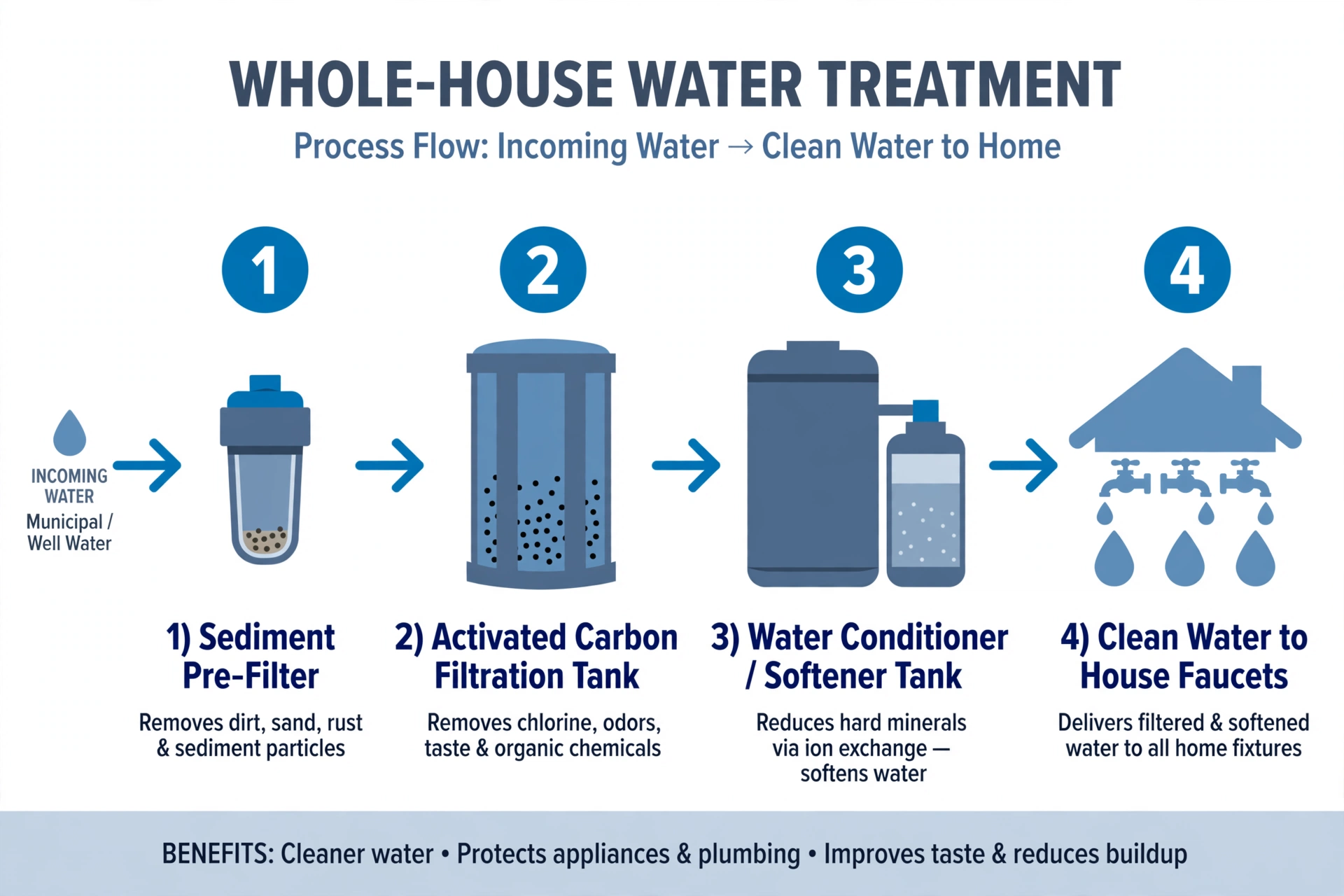
City water, chlorine + moderate hardness:
Sediment pre-filter → carbon filtration → salt-free conditioner (if scale is a concern). One or two tanks, minimal maintenance. This is the most common whole-house setup in America.
Well water, iron + sulfur + hardness:
Sediment pre-filter → iron/sulfur oxidation + media filtration → carbon polishing → softener or conditioner → (UV if bacteria is a concern). More stages, sized to lab results — this is “configured system” territory.
Notice what never appears: a single magic box that does everything. Anyone selling you one is selling marketing.
What this costs
Ballpark installed-equipment costs (DIY-friendly systems; pro installation adds $500–$1,500):
- Sediment pre-filter: ~$50–$150
- Whole-house carbon system: ~$380–$2,000
- Salt-free conditioner: ~$1,100–$1,600
- Salt-based softener: ~$1,500–$2,500
- Filter + softener bundle: ~$2,400–$3,300
- UV system: ~$300–$800
Our cost guide breaks down 10-year total ownership — purchase price is only the beginning.
Where to go from here
- Know your problem? Jump to the guide that matches: best whole house filters (city water/chlorine), hard water, sulfur smell, costs, salt-free vs. salt.
- Not sure? Take our Find Your System quiz — four questions, 2–3 honest recommendations.
- Want to know how we evaluate products? How we review water filters.
Frequently asked questions
Do I need a whole-house filter if my city water meets EPA standards?
Legally safe and pleasant are different things. Municipal water can meet every standard and still taste like a swimming pool. Carbon filtration is about taste, odor, and the chemicals you don’t want — not about meeting minimum legal thresholds.
Can one system remove chlorine AND soften water?
Yes — as a bundle (carbon tank + softener tank, like the combos in our hard water guide). No — as a single tank doing both jobs well. Two problems, two stages.
Is a salt-free conditioner a waste of money?
No, as long as you buy it for what it is: scale control. It becomes a waste of money when it’s sold as “salt-free softening” to someone who wanted truly soft water. Know which one you want before you shop.
Should I get a water test before buying?
Yes — especially for well water. A $30–$50 lab test is the cheapest part of this entire process and the one most people skip. For city water, your utility’s annual water quality report is a free starting point.
New guides
- Well Water Treatment: The Complete Guide
- Iron in Well Water
- Chlorine & Chloramine Removal
- Manganese in Well Water: Black Stains & What Actually Fixes Them
- Sediment Filters: What They Do, What They Don’t, and How to Pick One
- Bacteria in Well Water & UV Purification: What Actually Works
- PFAS in Drinking Water: What They Are and What to Do
- How to Test Your Drinking Water (Before You Buy Anything)
Get the right filter the first time
New guides, honest comparisons, and deal alerts. A few emails a month, no spam.