
Disclosure: We may earn a commission if you buy through our links. Full disclosure
All prices were observed on 2026-09-30 and change often, always check the live price on the linked page before buying.
Quick Verdict: Our top-rated salt-free TAC conditioner for city water is the cartridge-based Kind E-3000 (review)—or the conditioner-only Kind E-2000 (review) if you don’t need carbon filtration—followed by the dual-tank Aquasana Rhino Salt-Free.
A salt-free “conditioner” is not a water softener, and no honest person should sell it as one.
| Salt-based softener | Salt-free conditioner | |
|---|---|---|
| Removes hardness minerals | Yes — ion exchange | No — nothing leaves the water |
| Hardness test after install | Reads near zero | Reads the same number |
| Salt, water waste, power | Yes, yes, yes | None |
| Soap lather and “feel” | Soft-water slip | Unchanged |
The crystallization media (TAC/NAC) converts dissolved hardness into microscopic crystals that ride through your plumbing instead of sticking to it — genuine scale reduction, not softening. If you buy one of these expecting soft water, you have bought the wrong category, and the industry’s fondness for the word “softener” in product names is the trap. Our salt-free vs. salt softener guide walks the full decision.
On the evidence: The most credible independent reference we found is Germany’s DVGW testing protocol W-512, which Aquasana cites for its 99.6% scale-reduction figure, that’s one manufacturer’s claim about its own tested media, not a whole-system certification. We checked the live NSF, WQA, and IAPMO directories on 2026-09-30: no salt-free conditioner on this page carries a system-level certification for scale reduction. Kind lists its components as NSF/ANSI 42, 61, and 372 certified, component-level, not a certified system. The electronic descaler has no independent testing at all, and the treatment industry’s own reference literature (Pure Water Gazette’s water-treatment surveys) notes that, with the exception of TAC, no scale-prevention device has survived rigorous third-party testing. That doesn’t mean conditioners do nothing. It means you should know exactly what kind of evidence you’re buying on.
Before anything else: test first, treat second. Get your hardness in grains per gallon (gpg), a lab test ($100–$300) or our testing guide will get you there. The decision tree is short: if you want genuinely softer water, silkier showers, better soap lather, no spots on dishes, you want a salt-based softener, not this page. If your hardness is mild-to-moderate, your main complaint is scale buildup in the water heater and appliances, and you want zero salt, zero wastewater, and zero electricity, keep reading. New to water treatment generally? Start with Water Treatment 101 or take the Find Your System quiz.
Find your system
Know your water. Buy the right treatment. Answer a few questions about your water source and symptoms, and we narrow 49 systems down to your shortlist.
Short answer
- Want genuinely soft water — the feel, the lather → you need a salt softener, not this category.
- Scale control without salt on hard water → SpringWell FutureSoft FS1.
- Budget experiment → iSpring ED2000 (~$150), with eyes open about the evidence.
Our picks at a glance
- Best for high-hardness salt-free scale control: SpringWell FutureSoft FS1, TAC media, 12 GPM, rated to 81 gpg, lifetime warranty; ~$1,450–$1,600
- Best compact whole-house bundle: Kind E-2000, eSoft TAC + 20″ sediment pre-filter in a wall-mount box, 15 GPM, rated to 75 gpg; ~$1,050–$1,220
- Best established test record: Aquasana EQ-AST SimplySoft, NAC media Aquasana says was independently tested to reduce scale 99.6% (DVGW W-512); 7.0 GPM, ~$999
- Best budget electronic experiment: iSpring ED2000, plug-in electromagnetic coil, no plumbing changes, ~$150, the weakest evidence tier on this page
And the most important line in this guide: none of these softens water. Hardness minerals stay in your water by design. If “soft water” is what you actually want, read our hard-water roundup for the softener side of the decision instead.
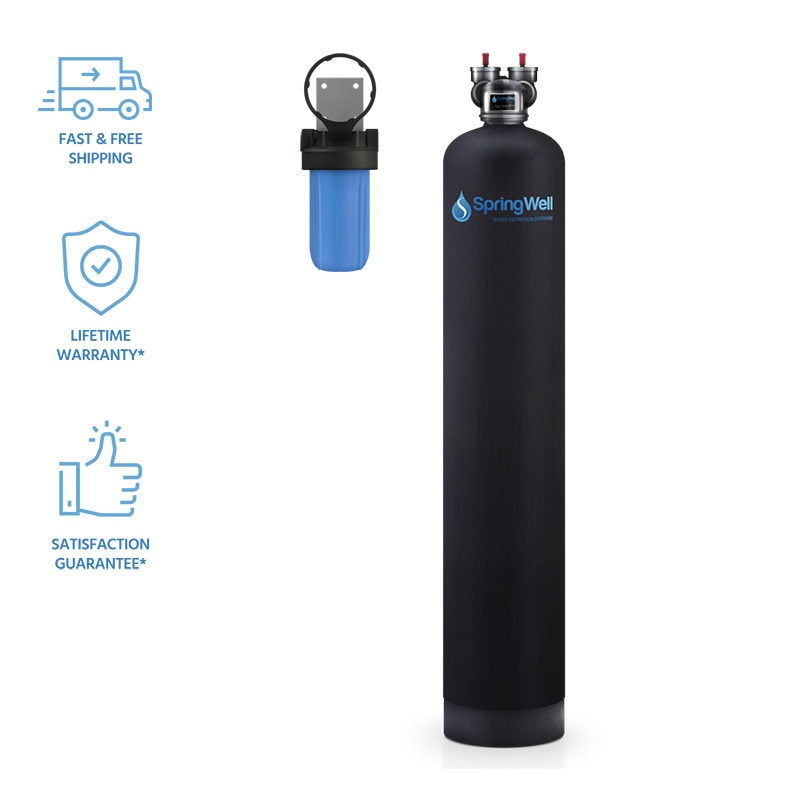
1. SpringWell FutureSoft FS1, Best for high-hardness salt-free scale control
Price: ~$1,450–$1,600 (FS1, 1–3 bathrooms; FS4 runs ~$1,960, FS+ ~$2,660, prices across listings checked 2026-09-30), Check current price at SpringWell Flow rate: 12 GPM service (FS1; FS4 15 GPM, FS+ 20 GPM) Design: Upflow tank of TAC (template-assisted crystallization) media with ActivFlo distribution; no electricity, no drain line, no backwash; optional sediment pre-filter recommended ahead of the tank Capacity: 1,000,000 gallons / roughly 10 years of media life per SpringWell Replacement cost: Sediment pre-filter ~$35 every 9 months → ~$40–$60/year; no media replacement inside a normal decade Warranty: Lifetime on tanks and valves (media excluded) Certification: None at the system level. A live NSF directory search for “SpringWell” on 2026-09-30 returned zero matching manufacturers. SpringWell cites 99.6% scale prevention via “certified TAC media”, that’s media-level language from a third-party listicle; we could not verify a live certification behind the system’s scale claims. 10-year cost of ownership: $2,200–$2,700 ($220–$270/yr) (install $300–$600 estimated, plus pre-filters)
Verdict: The biggest tank, the highest rated hardness ceiling (81 gpg), and the lifetime warranty in this guide, the salt-free pick for genuinely hard water, with the caveat that the 81-gpg rating is SpringWell’s claim, not an independent certification.
The FutureSoft FS1 is the one pick in this guide sized like real equipment: a full mineral tank with enough TAC media for 12 GPM service flow and a manufacturer-stated hardness ceiling of 81 grains per gallon, far above the 15-gpg line where most conditioner makers quietly point you toward a softener. The mechanism is the honest one for the category: template-assisted crystallization converts dissolved calcium and magnesium into microscopic calcite crystals that stay suspended instead of bonding to surfaces. No salt, no electricity, no drain, no backwash, and a million-gallon media life means you may never open the tank. For a homeowner whose complaint is scale, crusty water-heater elements, shortened appliance life, at genuinely high hardness, this is the most capable salt-free answer we found.
FutureSoft trade-offs: this does not soften water. Your hardness test will read the same number after installation; soap behavior, spotting, and the “feel” of the water change little or not at all. The 81-gpg ceiling is a manufacturer rating with no independent certification behind it, treat it as a design target and size conservatively, especially since TAC media is sensitive to water chemistry: iron, sediment, chlorine, and copper all shorten media life or foul it (the industry reference literature is explicit on this), which is why a sediment pre-filter and a chlorine-free feed matter. Second, well water with any iron is a bad fit, TAC fouls on iron, and SpringWell’s own materials assume municipal-style water. Third, like everything here, the “99.6% scale prevention” figure is a manufacturer claim; unlike Aquasana, SpringWell doesn’t publish a named independent test protocol behind it. And the link above is plain: our SpringWell affiliate application is still pending.
Buy it if: your hardness is high (toward the double digits in gpg), your complaint is scale rather than water feel, you’re on municipal water without iron, and you want the biggest media bed and the strongest warranty in the category. Skip it if: you want soft water (buy a softener), your water has iron or manganese (fouls TAC media), or you need filtration for chlorine/taste, the FS1 conditions only, it filters nothing.
2. Kind E-2000, Best compact whole-house bundle
Price: ~$1,050–$1,220 (listed $1,352.93, on sale across kindwater.com and Home Depot, range across listings checked 2026-09-30), Check current price at Kind (plain link, our Kind affiliate application is still pending, so we earn nothing from this link) Flow rate: 15 GPM, up to 5 bathrooms Design: Wall-mount box (29″H × 5.5″W × 8″D): 20″ pleated washable sediment pre-filter (95% of rust, sand, dirt, debris per Kind) + eSoft salt-free TAC cartridge; no electricity, zero wastewater Capacity: Rated to 75 gpg (1,282 ppm) max hardness; pH 6.5–9.5; 25–120 PSI; 1″ NPT Replacement cost: ~$100/year (Kind’s own upkeep figure; 10-minute DIY cartridge/sediment service) Warranty: Limited lifetime + 120-day satisfaction guarantee Certification: Kind states its components are NSF/ANSI 42, 61, and 372 certified and independently tested, component-level certifications, not a system-level certification for scale reduction. We found no live system listing for the E-2000’s scale claims on 2026-09-30. 10-year cost of ownership: $2,300–$2,900 ($230–$290/yr) (install $300–$600 estimated, Kind says 40% of buyers DIY, plus ~$100/year upkeep)
Verdict: The only pick that pairs TAC conditioning with real sediment filtration in a wall-mount box that needs no floor space, and the friendliest install story here. Its 88% scale-reduction figure and 75-gpg ceiling are Kind’s claims, on component-level (not system-level) certifications.
The E-2000 is the thoughtfully engineered pick: sediment filtration first (TAC media performs better and lasts longer on clean, sediment-free water, the industry literature backs this), then eSoft TAC conditioning, in a wall-mounted unit that takes zero floor space and that Kind says 40% of customers install themselves. At 15 GPM it has the highest service flow of any pick here relative to its footprint, and Kind publishes the water-chemistry limits most brands hide: max iron 0 mg/L, max hydrogen sulfide 0, pH 6.5–9.5. The limited lifetime warranty plus a 120-day satisfaction guarantee is the strongest try-before-you-commit terms in this guide. For a city-water home that wants conditioning plus basic filtration in one compact box, the E-2000 is the most complete answer.
E-2000 trade-offs: it still doesn’t soften water. Kind’s own product language is careful (“minerals stay, hardness crystallized”), and Kind’s site positions the system’s 88% scale-reduction figure alongside “no slimy feeling”, the honest signal that your water will feel like hard water, because it is hard water. The filtration stage handles sediment only, not chlorine, not taste and odor; if you want those, Kind’s E-3000 adds carbon, at a higher price. Second, the water-chemistry limits cut both ways: max iron 0 means any well water with iron is disqualified, and Kind’s own FAQ steers well-water buyers elsewhere. Third, the certification picture is component-level; “NSF/ANSI certified” on the product page refers to components (42, 61, 372), and we found no live system-level listing for the E-2000’s scale claims. Finally, the link is plain — our Kind affiliate partnership (via Awin) is now live.
Buy it if: you’re on city water, you want conditioning plus sediment filtration in the smallest footprint here, you might DIY the install, and you value the 120-day satisfaction guarantee. Skip it if: your water has any iron (Kind disqualifies it), you need chlorine/taste filtration (step up to the E-3000 or a separate filter), or you want soft water, this conditions, it doesn’t soften.
3. Aquasana EQ-AST SimplySoft, Best established test record
Price: ~$999 (Aquasana’s standalone conditioner; retailer and auction records cluster $750–$1,000, price observed 2026-09-30), Check current price at Aquasana Flow rate: 7.0 GPM service Design: Dual-tank NAC (nucleation-assisted crystallization) conditioner, Aquasana’s term for a crystallization approach similar to TAC; no salt, no electricity, no drain Capacity: 600,000 gallons / 6 years of media life per Aquasana (“maintenance free for 6 years”) Replacement cost: Whole replacement tank at year 6 (EQ-AST-R; current price not found at our check) → effectively ~$125–$165/year amortized against the ~$999 original, plus any pre-filter you add Warranty: 6-year limited Certification: No system-level listing. Aquasana’s two evidence claims: (1) the NAC media is “NSF Certified” (brand language, we could not verify a system listing, and it reads as a media/material claim), and (2) Aquasana says the media was independently tested by DVGW to protocol W-512, showing 99.6% scale reduction, a named independent test, which is more than any other pick on this page publishes. 10-year cost of ownership: $2,000–$2,600* ($200–$260/yr) (install $300–$600 estimated, plus a replacement tank at year 6, price not published, assumed near the original)
Verdict: The pick with the most specific independent test behind it, Aquasana names the lab protocol (DVGW W-512) and the number (99.6%). The trade: the lowest flow rate here, the shortest media life, and a replacement tank whose current price we couldn’t find.
Aquasana is the only brand on this page that points at a named third-party test instead of a bare percentage: DVGW (the German technical-scientific gas and water association) protocol W-512, with a claimed 99.6% scale reduction. That is still a manufacturer claim about its own tested media, not a certification of your system, but a named, independently run protocol is a meaningfully higher evidence tier than “certified media” language alone. The EQ-AST is also the unit Aquasana bundles into its Rhino whole-house systems (the SimplySoft stage in the EQ-1000-AST and well-water bundles), which means its real-world footprint is large and its upkeep story is simple: nothing to do for six years, then swap the tank.
SimplySoft trade-offs: 7.0 GPM is the lowest service flow in this guide, adequate for small-to-medium homes, tight for a large household running multiple showers. Six years of media life is the shortest here, and the replacement tank (EQ-AST-R) exists but we couldn’t find a current price, your 10-year math has a hole in it until you confirm that number. Second, Aquasana’s own bundle marketing publishes the suitability bounds most conditioner brands won’t: the technology is “best suited” for hardness below 15 grains per gallon, alkalinity under 250 mg/L, pH below 8.3, and iron under 0.3 ppm. Take that as the industry’s honest ceiling for crystallization conditioning: above ~15 gpg, buy a softener. Third, it conditions only, no filtration, no chlorine reduction; pair it with a filter (or buy the Rhino bundle) if your water needs that. And one naming warning: Aquasana also sells a salt-based softener called SimplySoft (WH-SF40/WH-SF60, NSF/ANSI 44 certified), a genuinely different product. Make sure you’re looking at the EQ-AST salt-free conditioner, not the salt softener, before you buy.
Buy it if: your hardness is under ~15 gpg, you want the most specifically documented test record in the category, and your household fits inside 7 GPM. Skip it if: your hardness exceeds ~15 gpg (Aquasana itself says this is softener territory), your peak demand tops 7 GPM, or the unpriced year-6 replacement tank bothers you, confirm that number first.
4. iSpring ED2000, Best budget electronic experiment
Price: ~$150 (US retail, check current price), Check current price Flow rate: N/A, it’s a plug-in box with two antenna wires you coil around your main water pipe; no flow restriction, works on any pipe including PEX and PVC Design: Electronic descaler: wraps two antenna cables around the main pipe, generating what iSpring describes as a complex, frequency-modulated electromagnetic waveform that agitates water molecules, releases CO₂, and triggers premature precipitation of calcium bicarbonate, in theory, making the water slightly more soluble so it can dissolve existing scale Capacity: No media, no gallons rating; designed per iSpring for “very hard water areas (10–19 grains per gallon)”, a manufacturer claim Replacement cost: $0, no consumables, no maintenance Warranty: 1-year manufacturer warranty; 1-year money-back guarantee; lifetime technical support Certification: None, no NSF, WQA, or IAPMO listing of any kind, and no named independent test protocol. This is the weakest evidence tier on this page by a wide margin. 10-year cost of ownership: ~$150 (~$15/yr) (DIY install, no plumbing modifications; nothing to replace)
Verdict: The $150 curiosity: no plumbing, no maintenance, no ongoing cost, and no independent evidence that it works. Include it as an experiment with a money-back guarantee, never as a treatment plan.
The ED2000 exists for one buyer: the skeptic who wants to try something for $150 before spending $1,000+ on a tank system, and who accepts that the something might do nothing. The pitch is real convenience, coil two wires around the main pipe, plug it in, no plumber, no salt, no drain, no maintenance, works on PEX and PVC where magnetic clamps are debated, and iSpring’s own listing is at least honest that “the ED2000 is not a water softener, and does not remove hard minerals from your water.” The 1-year money-back guarantee means the experiment is refundable.
ED2000 trade-offs: there is no independent evidence this works. No certification, no named test protocol, no published third-party study, the mechanism description (frequency-modulated electromagnetic waveform triggering premature precipitation) is iSpring’s marketing physics. The water-treatment industry’s own reference literature notes that, with the exception of TAC, no scale-prevention device has survived rigorous third-party testing, and this is not TAC. Retailer reviews are mixed, with some buyers reporting no visible results after a month. If scale is genuinely costing you money, water-heater elements, appliance life, a $150 unproven device is not the rational bet; it’s a lottery ticket with a refund policy. Buy it only if you understand that.
Buy it if: you want a $150, zero-commitment experiment with a 1-year money-back guarantee, you rent or can’t modify plumbing, and you accept the very real chance it does nothing. Skip it if: scale is costing you real money (buy crystallization media with a named test record, or a softener), or you need certainty, nothing on this page is less certain.
At a glance: the four picks compared
| SpringWell FutureSoft FS1 | Kind E-2000 | Aquasana EQ-AST SimplySoft | iSpring ED2000 | |
|---|---|---|---|---|
| Best for | High-hardness salt-free scale control | Compact whole-house bundle | Most specific independent test record | Budget electronic experiment |
| Price (2026-09-30) | $1,450–$1,600 | $1,050–$1,220 | $999 | ~$150 |
| Flow rate (service) | 12 GPM | 15 GPM | 7.0 GPM | N/A (pipe coil) |
| Technology | TAC crystallization tank | eSoft TAC cartridge + sediment pre-filter | NAC crystallization dual tank | Electronic electromagnetic coil |
| Max rated hardness | 81 gpg (manufacturer claim) | 75 gpg (manufacturer claim) | Below 15 gpg (manufacturer’s own guidance) | 10–19 gpg (manufacturer claim) |
| Softens water? | No | No | No | No |
| Scale evidence | Manufacturer claim (99.6%) | Manufacturer claim (88%) | DVGW W-512 test, 99.6% (manufacturer claim) | None published |
| Independent certification | None | Components only (NSF/ANSI 42, 61, 372) | None system-level (“NSF Certified” media language) | None |
| Annual upkeep | $40–$60 | ~$100 | $0 for 6 yrs, then re-tank | $0 |
| 10-year cost of ownership | $2,200–$2,700 | $2,300–$2,900 | $2,000–$2,600* | ~$150 |
| Annualized cost | $220–$270/yr | $230–$290/yr | $200–$260/yr | ~$15/yr |
| Warranty | Lifetime (tanks/valves) | Limited lifetime + 120-day guarantee | 6-year limited | 1-year; 1-year money-back |
*Aquasana replacement tank (EQ-AST-R) price not published, assumes re-tank near original price. All prices observed 2026-09-30; verify at purchase.
How to choose: the 5-minute salt-free buying guide
1. Decide what you actually want: softer water, or less scale. This is the whole decision. If you want silkier showers, better soap lather, and spot-free dishes, you want a salt-based softener, read our salt-free vs. salt guide and our hard-water roundup instead of this page. A conditioner will not give you any of those. What a conditioner does is protect plumbing, water heaters, and appliances from new scale, and that’s a real, money-saving job for the right household. Buy the category that matches the complaint.
2. Know your hardness number, it draws the line between conditioner and softener. Get grains per gallon from a lab test, not a strip. Under ~7 gpg (mild): a conditioner is a reasonable, low-hassle answer. 7–15 gpg (moderate): conditioning is defensible, Aquasana’s own published guidance says its technology is “best suited” below 15 gpg. Above ~15 gpg: that’s softener territory in the industry’s honest accounting, whatever any single brand’s headline rating says. SpringWell rates the FutureSoft to 81 gpg and Kind the E-2000 to 75 gpg, those are manufacturer claims with no independent certification behind them. Size conservatively and hold the vendor to your number.
3. Check the water chemistry, crystallization media is picky. TAC/NAC media fouls on iron (Kind’s published limit is literally 0 mg/L), degrades with chlorine exposure, and needs sediment-free water to keep its nucleation sites working, the industry reference literature is explicit that TAC units should be protected from sediment and chlorine. Aquasana’s own bounds: alkalinity under 250 mg/L, pH below 8.3, iron under 0.3 ppm. If your water has iron, manganese, or sulfur, treat those first (or buy a softener, which tolerates some iron); a conditioner on fouling water is a conditioner that quietly stops conditioning.
4. Remember what a conditioner doesn’t do: taste, odor, chlorine. None of the four picks filters anything except the Kind’s sediment stage. If your water also tastes of chlorine or smells off, you need filtration too, which is why Aquasana and Kind both sell bundles (Rhino + SimplySoft, E-3000) that pair conditioning with carbon filtration. Don’t buy a conditioner expecting better-tasting water; that’s a separate stage, and a separate budget line.
5. Compare against the softener you didn’t buy. Our cost-of-ownership database puts 10-year totals for these four between ~$150 and ~$2,900. The honest comparison is against a salt softener: $150–$400/year in salt alone (Kind’s own figure), plus water waste from regeneration. Conditioners win on running costs and lose on capability, no salt bags, no brine, no drain, but no soft water either. Ask “what does the hardness cost me?” (appliance life, energy, cleaning) and “what does the alternative cost?” before “what does the box cost?”
Frequently asked questions
Will a salt-free conditioner make my water soft? No. Crystallization media converts dissolved calcium and magnesium into microscopic crystals that don’t stick to surfaces, the minerals stay in your water, and a hardness test will read the same number after installation. “Salt-free softener” is marketing language for a conditioner. If you want soft water, buy a softener.
Will spots on my dishes and fixtures disappear? Not reliably. Because the minerals remain in the water, spotting can still occur, reviewers of crystallization systems commonly report that spots still appear but wipe off more easily, since the crystals don’t bond the way raw scale does. If spot-free dishes are the goal, that’s a softener (or a dishwasher rinse aid), not a conditioner.
Does TAC/NAC remove existing scale? Mostly no, it’s preventive. SpringWell’s marketing claims the FutureSoft helps with existing scale, and iSpring claims its electronic unit “allows existing scale to break down”, both are manufacturer claims with no independent verification. Buy a conditioner to stop new scale; don’t buy one as a descaling service for twenty years of buildup.
What’s the difference between TAC and NAC? Nearly nothing, functionally. TAC (template-assisted crystallization) and NAC (nucleation-assisted crystallization) both describe media that converts dissolved hardness into suspended microcrystals via nucleation sites. The names are different brands’ trademarks for the same class of technology. Treat them as one category when comparing.
Do these need electricity, salt, or a drain? No, none of the four. That’s the genuine appeal: no salt bags, no brine discharge, no regeneration water waste, no power outlet. The trade is capability: they condition, they don’t soften.
How long does the media last? Typically 3–6 years for cartridge media, longer for full tanks: Aquasana rates the EQ-AST at 6 years / 600,000 gallons, SpringWell rates the FutureSoft at 10 years / 1,000,000 gallons, and Kind’s E-2000 uses replaceable cartridges on roughly annual service. Media life assumes clean, iron-free, low-chlorine feed water, fouling shortens it.
Can I use a salt-free conditioner on well water? Only if the well water is otherwise clean. Iron is the disqualifier: Kind publishes a 0 mg/L iron limit, Aquasana’s guidance caps iron at 0.3 ppm, and the industry literature says TAC media fouls on iron, manganese, and sediment. Get the full mineral panel first, a conditioner on iron-bearing well water is money spent on media that will foul.
Is the iSpring ED2000 a scam? We wouldn’t use that word, iSpring is a real company with a real money-back guarantee, and its listing honestly says the unit is not a softener. But there is no independent evidence it works: no certification, no named test protocol, no published study. The water-treatment industry’s own reference literature notes that no scale-prevention device other than TAC has survived rigorous third-party testing. Treat it as a $150 experiment with a refund policy, not as treatment.
Which salt-free water conditioner has the longest media lifespan?
By manufacturer rating, the SpringWell FutureSoft FS1. Its TAC media is rated for 1,000,000 gallons — roughly 10 years — and SpringWell schedules no media replacement inside a normal decade (just a ~$35 sediment pre-filter about every 9 months). The Aquasana SimplySoft is next at 600,000 gallons / 6 years, after which the whole conditioner tank is replaced; its 6-year limited warranty matches that rated lifespan exactly. Kind’s E-2000 and E-3000 run the shortest rated interval — the eSoft cartridge is replaced every 3–5 years — but it is a $799.99 cartridge swap (about 10 minutes, DIY), and Kind backs the systems with a lifetime warranty. One caution that applies to all three: these are manufacturer service-life ratings, not independently tested media lifespans, and none of the three carries system-level NSF certification for its scale claims.
What are the best alternatives to discontinued Pelican NaturSoft salt-free systems?
Pentair has discontinued the Pelican NaturSoft line — the NS3 conditioner (sold in the PSE1800 combo) and the NS6 (in the PSE2000) — so there is no current NaturSoft system to buy. NaturSoft was TAC, and the direct like-for-like replacements are the current TAC systems in this roundup: the Kind E-2000 if you want conditioner-only in a compact box, the Kind E-3000 if you also want the carbon filtration stage the NaturSoft combos paired with it, and the SpringWell FutureSoft FS1 (section 1 above) if you prefer a full-size tank with the longest rated media life. If your NaturSoft system is still conditioning, there is no rush — replace it when the scale protection fades, and size the replacement by your hardness and flow rate, not by the old system’s footprint.
Who it’s for
Salt-free conditioners do one job, reduce new scale without salt, water waste, or electricity, and the honest ones admit it’s the only job they do. For high-hardness scale control, the SpringWell FutureSoft FS1 (~$1,450–$1,600) brings the biggest TAC bed, a 12 GPM flow, and a lifetime warranty, on manufacturer claims, not a certification. For a compact whole-house bundle, the Kind E-2000 (~$1,050–$1,220) pairs eSoft TAC with sediment filtration in a wall-mount box with the friendliest install story and the clearest published water-chemistry limits. For the most specifically documented test record, the Aquasana EQ-AST SimplySoft (~$999) points at an actual independent protocol (DVGW W-512, 99.6%), with the lowest flow here and an unpriced year-6 replacement tank to confirm. And the iSpring ED2000 (~$150) is the budget electronic experiment, no plumbing, no maintenance, and no independent evidence it works. Whatever you buy, buy it for scale prevention, not soft water: if silkier showers and spot-free dishes are what you want, you want a salt-based softener, and this page will have done its job if it talked you out of the wrong category. If you’re torn between the two salt-free finalists, our Kind vs SpringWell comparison puts them head to head on flow, footprint, maintenance, and decade cost.
How we evaluate: We don’t own a test lab, so we won’t pretend we installed four conditioners on four water heaters and waited two years. Our picks are drawn from our own research databases of 50 whole-house systems, tracking certification records, flow rates, and real cost of ownership, plus manufacturer-published specs, warranty terms, and the independent literature on crystallization media. For every performance claim, we say whose it is: the manufacturer’s, a certification body’s, or ours. In this category the discipline matters more than usual, because no salt-free conditioner on this page removes hardness minerals, and most carry no system-level certification for their scale claims, we’ll tell you exactly what the evidence is instead.
Compare the data
All 49 systems side by side. Filter by price, flow rate, certifications, and estimated 10-year ownership cost.
Check current prices: SpringWell FutureSoft · Kind E-2000 · Aquasana SimplySoft · iSpring ED2000 — prices change often, verify live before buying.
What to do next
- Test your water — get a lab test before buying anything: how to test your water.
- Identify the treatment — match your test results to the right equipment: Water Treatment 101.
- Compare systems — filter 49 whole-house systems by your problem, flow, and budget: System Finder.
- Compare salt-free combos — need filtration and scale conditioning in one purchase: filter + conditioner combos.
- Calculate 10-year cost — the sticker price is the cheapest part of owning a system: cost guide.
- Find your system — answer four questions and get your shortlist: Find Your System quiz.
Sources & Verification
Every performance claim in this guide traces to one of three places: the manufacturer’s own published specs, a live certification-body listing, or our own cost-of-ownership math. We checked the following on 2026-09-30.
SpringWell FutureSoft specs and pricing. FS1 (1–3 bathrooms) ~$1,597.31, FS4 ~$1,960.43, FS+ ~$2,657.63 per a third-party review’s price table; other listings cite ~$1,452. TAC media, upflow, 12–20 GPM by size, max hardness 81 gpg, pH 7.0–9.5, 1,000,000-gallon / ~10-year media life, lifetime warranty on tanks and valves, all per SpringWell’s product materials as reported by reviewers. (SpringWell, salt-free water softeners; pricing and specs via WaterFilterGuru review and QualityWaterLab review.) No NSF, WQA, or IAPMO system-level listing found for SpringWell.
Kind E-2000 specs and pricing. 15 GPM, up to 5 bathrooms, max hardness 75 gpg (1,282 ppm), eSoft salt-free TAC, 20″ pleated washable sediment pre-filter, wall-mount 29″H × 5.5″W × 8″D, 1″ NPT, 25–120 PSI, pH 6.5–9.5, max iron 0 mg/L, max hydrogen sulfide 0, ~$100/year upkeep, limited lifetime warranty + 120-day satisfaction guarantee, “88% scale reduction”, all per Kind’s product page. Listed $1,352.93, on sale ~$1,050–$1,220 across kindwater.com and Home Depot at our check. Kind states components are NSF/ANSI 42, 61, and 372 certified; we found no system-level listing for the E-2000’s scale claims. (Kind Water Systems, E-2000 whole-house salt-free water softener; chemistry limits via the E-2000 user manual.)
Aquasana EQ-AST SimplySoft specs and pricing. ~$999 standalone conditioner (check current price); 7.0 GPM service; 600,000-gallon / 6-year media life; 6-year limited warranty on US models; no salt, electricity, or drain. NAC media described by Aquasana as “NSF Certified” (media-level brand language, no system listing found) and claimed independently tested by DVGW to protocol W-512 with 99.6% scale reduction. Aquasana’s own marketing bounds the technology: best suited below 15 gpg hardness, alkalinity under 250 mg/L, pH below 8.3, iron under 0.3 ppm. Note: Aquasana also sells a salt-based SimplySoft softener (WH-SF40/WH-SF60, NSF/ANSI 44), a different product. (Aquasana Europe, EQ-AST product page; 6-year warranty per US retail listing; suitability bounds via a retailer listing reproducing Aquasana’s bundle copy.)
iSpring ED2000 mechanism and evidence. ~$150 (US retail, check current price); plug-in unit with two antenna wires coiled around the main pipe; iSpring describes a frequency-modulated electromagnetic waveform meant to trigger premature precipitation of calcium bicarbonate. iSpring’s own listing states “the ED2000 is not a water softener, and does not remove hard minerals from your water.” No certification, named test protocol, or published third-party study found. (Amazon, iSpring ED2000 listing.)
TAC mechanism and independent literature. Template-assisted crystallization converts dissolved calcium and magnesium into microscopic crystals at nucleation sites on polymer beads; the crystals detach and stay suspended rather than adhering to surfaces, it does not remove hardness. TAC media typically lasts about three years in cartridge form (longer in full tanks), requires no power, chemicals, or backwashing, and should be protected from sediment, chlorine, copper, and iron. Industry reference literature notes TAC is the only scale-prevention device to have survived rigorous third-party testing; electronic/magnetic devices have not. (Pure Water Products, Template Assisted Crystallization; Pure Water Gazette, Water Treatment: What Works and What Doesn’t; Pure Water Gazette, Scale Prevention Alternatives.)
Certification-directory checks. No live NSF, WQA, or IAPMO system-level listing was found for any of the four systems’ scale-reduction claims on 2026-09-30. Verify any “NSF certified” claim yourself at NSF’s drinking-water directory or the WQA product directory.
Cost-of-ownership data. The 10-year totals and annual upkeep figures above are our own math from equipment prices, published consumable costs, and our cost-of-ownership database methodology. Install-cost figures are our planning estimates based on observed market ranges, not quotes.
Independent review: We may earn a commission if you buy through our links. This review is based on manufacturer specifications, certification records, and published pricing — not hands-on testing.
As an Amazon Associate we earn from qualifying purchases.
By the Pure Whole House Team