
Disclosure: We may earn a commission if you buy through our links. Full disclosure
All prices were observed on 2026-09-30 and change often, always check the live price on the linked page before buying.
Update (2026-09-30): Aquasana has retired the EQ-600 — it is no longer sold as a current model. This comparison is preserved for reference (the two systems were nearly identical), but if you are buying today, the EQ-1000 is the live option: check the current EQ-1000 price.
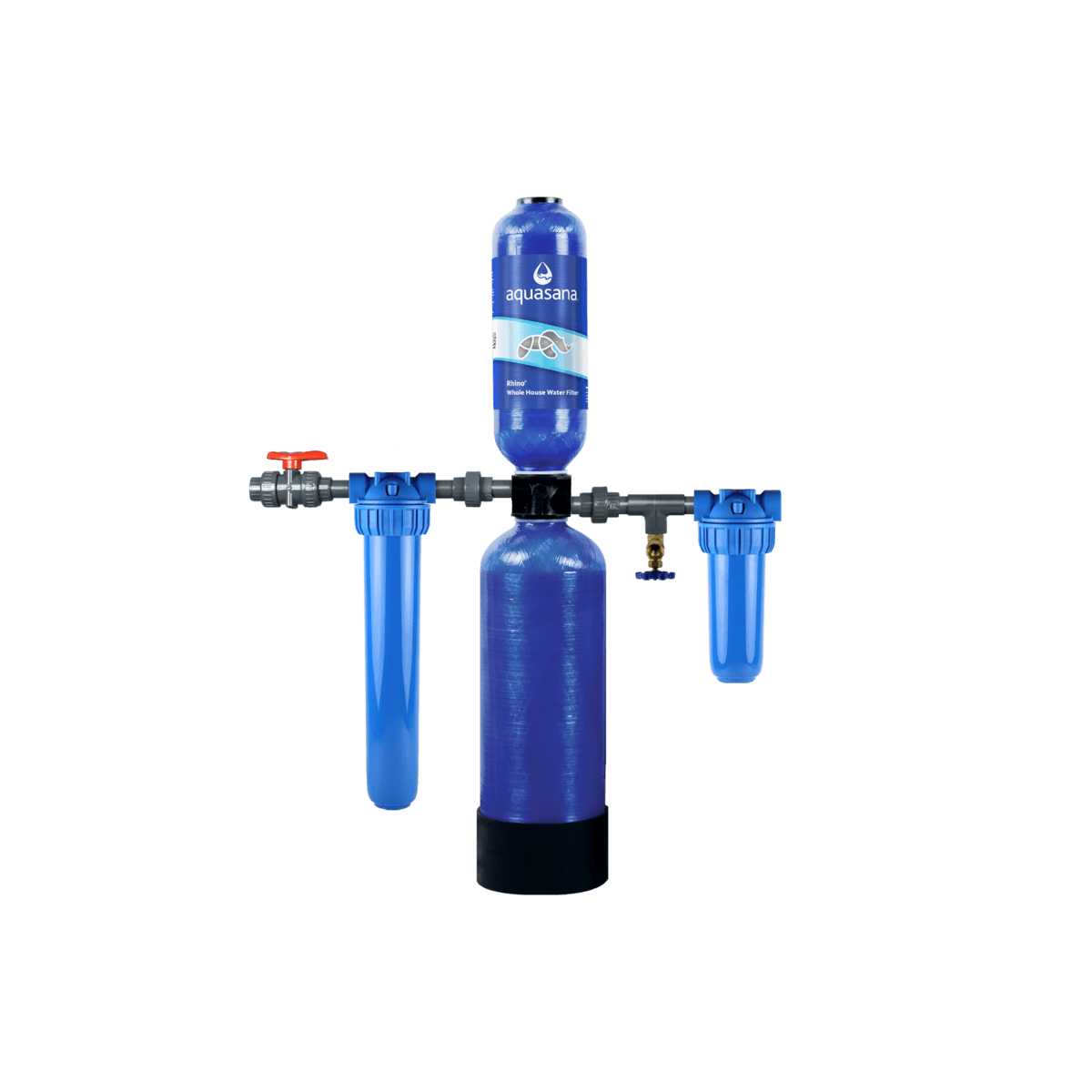
Aquasana’s whole-house lineup has an awkward secret: the EQ-600 and the EQ-1000 are the same filter wearing two price tags. Same carbon + KDF dual-tank design, same 7.0 GPM rated flow, same pre- and post-filter maintenance rhythm, same install footprint. The differences fit on an index card: the tank’s rated capacity (600,000 vs 1,000,000 gallons), the warranty (6 vs 10 years), and, most importantly, the decade math, which is not as obvious as the marketing makes it look.
The interesting part of this comparison: the EQ-600’s own performance data sheet makes a certification claim that doesn’t survive our verification. It reads “System Tested and Certified by NSF International against NSF/ANSI Standard 42 for the reduction of Chlorine Taste and Odor”, but our 2026-09-30 search of NSF’s drinking-water-treatment-unit listings found no EQ-600 listing (or any Aquasana whole-house listing). Aquasana’s EQ-1000 documentation is actually more honest about this: its manual says the tank is WQA-certified to NSF/ANSI/CAN 61 for materials safety only and explicitly notes it is “not certified for contaminant reductions by WQA.” Two models, two different stories about the same paper trail. This article tells you what we could actually verify for each.
Update 2026-09-30: Aquasana no longer lists the EQ-600 on its site, the whole-house lineup is now the 1M-gallon Rhino, Max Flow, and HealthShield. The comparison below is kept for reference.
Before anything else: both of these are city-water systems. Chlorine, chloramine, taste, odor, VOCs, sediment, that’s their job. They don’t soften hard water, they don’t treat well-water iron or sulfur, and they don’t disinfect. Get a lab test first ($100–$300), read our well-water guide if the results point that way, and new readers can start with Water Treatment 101 or take the Find Your System quiz.
Short answer
- Staying put 6+ years → the EQ-1000 wins the decade on cost.
- Smaller home, tight budget, or you may move soon → the EQ-600 on sale.
- More than ~3.5 bathrooms or heavy simultaneous use → neither; you need 15 GPM (the Kind E-1000).
At a glance
| Aquasana Rhino EQ-600 | Aquasana Rhino EQ-1000 | |
|---|---|---|
| Best for | Smaller homes and buyers who want the lowest entry price on the Rhino platform | Buyers staying put who want the cheapest per-year cost and a 10-year warranty |
| Price (2026-10-15) | List $1,498; promo pricing recently around $729–$999 (see pricing note) | $1,998 observed Oct 15, 2026 ($999–$1,100 when promos run) |
| Capacity | 600,000 gallons / 6 years | 1,000,000 gallons / 10 years |
| Chlorine reduction | 96.9% (independently tested per NSF/ANSI 42, tested, not certified) | 97% (independently tested per NSF/ANSI 42, tested, not certified) |
| Flow rate | 7.0 GPM rated | 7.0 GPM rated (14.6 GPM peak) |
| Design | Dual-tank carbon + KDF upflow bed, 10″ sediment pre-filter, post-filter | Dual-tank carbon + KDF upflow bed, 20″ sediment pre-filter, post-filter |
| Dimensions | 8″ diameter × 46″ tall, 40 lbs | 9″ × 46″ tall, 90+ lbs |
| Maintenance rhythm | Pre-filter every 2 months, post-filter every 6 months | Pre-filter every 2 months, post-filter every 6 months |
| Annual upkeep | $60–$100 (our database) | $100–$120 (our database) |
| Replacement tank | EQ-600R, ~$470–$699, at ~6 years | EQ-1000R, at ~10 years |
| 10-year cost of ownership | $2,099–$3,797 (incl. one replacement tank) | $3,298–$3,798 |
| Annualized cost | $210–$380/yr | $330–$380/yr |
| Warranty | 6-year limited (main tank) | 10-year limited (main tank); housings 12 months |
| Money-back guarantee | 90 days | 90 days |
| Certification | Data sheet claims NSF 42 certification; no live NSF listing found | Tested to NSF/ANSI 42 (97%); tank WQA-certified to 61, materials safety only |
| Certification check | 2026-09-30 — no NSF/WQA certification claimed by the manufacturer. | 2026-09-30 — no NSF/WQA certification claimed by the manufacturer. |
Pricing notes: the EQ-600’s list price is $1,498 per an older review of Aquasana’s site; third-party price references put recent promo pricing around $729–$999, in line with the EQ-1000’s observed $999–$1,100 promo range on 2026-09-30 ($1,998 as of Oct 15, 2026). The EQ-1000’s price swings with Aquasana’s deep promotions, so verify the live price. Buy link (tracked, we earn a commission): Aquasana EQ-1000.
Round 1: What you’re actually choosing, capacity and lifespan
Strip away the marketing and this is a capacity decision. The EQ-600’s media bed is rated 600,000 gallons or 6 years; the EQ-1000’s is rated 1,000,000 gallons or 10 years. Same carbon, same KDF (copper-zinc redox alloy), same dual-tank upflow design that lengthens contact time and avoids channeling. At the average household usage of ~100,000 gallons a year, the 600 needs a replacement tank (EQ-600R, roughly $470–$699) at about year 6; the 1000 runs to year 10 before its tank is done.
Everything else is close to identical. Both are rated 7.0 GPM (the EQ-1000’s 14.6 GPM “peak” figure is the rated number’s less-honest sibling, treat both as 7 GPM systems). Both cover homes up to ~3.5 bathrooms / 3,500 sq ft without noticeable pressure drop, per Aquasana’s own guidance. Neither needs backflushing, draining, electricity, or a wastewater line. The 1000 is a slightly bigger, heavier box (9″ diameter, 90+ lbs vs 8″, 40 lbs) with a longer 20″ pre-filter; the 600’s pre-filter is the shorter 10″ version.
Edge: this round is the whole comparison. You’re buying years of media life, nothing more.
Round 2: Filtration performance, tested figures, one contradiction
Both systems reduce chlorine, chloramine, VOCs, sediment, taste and odor through the same carbon + KDF architecture. The published tested figures differ by a rounding error: 96.9% chlorine reduction on the EQ-600’s data sheet (2 mg/L influent challenge, NSF/ANSI 42 test protocol, run across the full 600,000-gallon rating) versus 97% on the EQ-1000.
Now the part most reviews skip: the EQ-600’s performance data sheet says the system was “Tested and Certified by NSF International against NSF/ANSI Standard 42,” and Aquasana Europe markets “full system NSF Certification” for the line, but our 2026-09-30 search of NSF’s official drinking-water-treatment-unit listings found no EQ-600 listing and no Aquasana whole-house listing at all (only UV models AQ-UV-MF/SF under NSF/ANSI 55). Tested-to-a-standard’s-protocol is real evidence; certified-by-NSF is a different claim, and the public directory doesn’t back it. The EQ-1000’s manual, to its credit, is precise where the EQ-600’s data sheet is not: WQA-certified to NSF/ANSI/CAN 61 and CSA B483.1 “for Materials Safety Requirements Only”, explicitly “not certified for contaminant reductions.”
The honest reading: both have standard-tested chlorine figures from independent lab work, and neither carries a system-level contaminant-reduction certification. The EQ-1000’s paperwork is simply the more careful of the two.
Edge: EQ-1000, on documentation honesty, not on filtration, which is effectively tied.
Round 3: The decade math, where the EQ-1000 pulls away
This is the round that decides the purchase. Both systems need pre-filter swaps every 2 months (~$10 each for the EQ-600’s 10″ filters, about $60/year) and post-filter swaps every 6 months; our 49-system database puts annual upkeep at $60–$100 for the EQ-600 and $100–$120 for the EQ-1000.
EQ-600, 10 years: $729–$1,498 equipment + install ($300–$600) + 10 × $60–$100 upkeep ($600–$1,000) + one replacement tank EQ-600R (~$470–$699 at year 6) = $2,099–$3,797. The wide range is the promotion lottery doing its work. Correction 2026-09-30: the total printed here originally omitted the replacement tank from the sum; the figure above includes it.
EQ-1000, 10 years: $1,998 equipment + install ($300–$600) + 10 × $100–$120 = $3,298–$3,798 (observed Oct 15, 2026; the $999 sale ended — a returning promo cuts ~$1,000).
Two things fall out of this. First: at current pricing the EQ-600 wins the decade against the EQ-1000 at the low ends ($2,099 vs. $3,298) — the gap widened when the EQ-1000’s $999 sale ended — while at the high ends the two are effectively tied ($3,797 vs. $3,798). Second: that’s a big range, and the EQ-600 forces a second purchase decision in year 6 (the replacement tank), where prices and your memory both get a vote. The EQ-1000 is one purchase, one install, done for a decade. On a per-year basis the EQ-1000’s $330–$380/year of ownership is the more predictable number; the EQ-600’s is cheaper only if you actually complete the year-6 tank swap instead of letting it slide.
Edge: EQ-1000 for predictability; EQ-600 for the lowest possible decade, if you buy on sale and commit to the year-6 tank.
Round 4: Maintenance rhythm, same homework, smaller filters
Both Rhinos share the maintenance schedule that defines the line: pre-filter every 2 months, post-filter every 6 months. Eight cartridge touches a year. Miss the pre-filter and it clogs, flow drops, and the decade (or six-year) media claim degrades. Aquasana phrases it honestly on the EQ-1000: replace pre and post filters every 2 months “for best filtration and flow rate.”
The difference is filter size and cost: the EQ-600’s 10″ pre-filters run about $10 each (~$60/year for six), while the EQ-1000’s 20″ pre-filters cost more per piece. Slightly cheaper touches, same number of appointments. The discipline risk is identical, and it’s the real risk of this product line. If you’re the person who forgets the furnace filter, neither Rhino is your system; a once-a-year cartridge system like Kind’s E-1000 is.
Edge: EQ-600, barely, cheaper touches, same cadence.
Round 5: Warranty and guarantees
The EQ-1000’s 10-year limited warranty covers its 10-year-rated tank, honest coverage of the product’s actual lifespan. The EQ-600 gets 6 years for its 6-year tank. Housings are 12 months on both. Both carry the 90-day money-back guarantee and eligibility for the Water for Life program (15% off replacement filters, extended warranty).
Neither warranty covers labor or transfers to a new owner. The EQ-1000’s longer coverage is simply better buyer protection on a more expensive purchase, though it has to be, since the purchase costs more.
Edge: EQ-1000.
Round 6: Sizing, who actually needs the 1000?
Aquasana sizes both systems for homes under ~3,500 sq ft with 3.5 bathrooms or fewer, at 7.0 GPM rated flow. In practice, the EQ-1000’s million-gallon capacity and longer warranty make it the default for households that will use the water, 3+ bathrooms, simultaneous showers and laundry, long ownership horizon. The EQ-600 is the right box for a 1–2 bathroom home, a condo or townhouse with tight utility space (it’s smaller and 50 lbs lighter), or a buyer who wants onto the Rhino platform at the lowest entry price.
One honest sizing note: if your household genuinely needs more than ~7 GPM sustained, 4+ bathrooms, irrigation, body sprays, neither Rhino is the answer. Size up to something like Kind’s 15 GPM E-1000 instead. Buying the bigger Rhino doesn’t buy more flow; both top out at 7 GPM.
Edge: neither, it’s a fit question, not a better/worse one.
What neither of them does (read before you buy)
This is the section the manufacturers won’t write:
- Neither softens water. No conditioning or softening stage in either base unit, that’s the SimplySoft (AST) bundle on the EQ-1000, which the EQ-600 doesn’t offer. If hard water is the complaint, read our salt-free vs. salt softener guide before spending ~$1,000 on a filter that doesn’t touch hardness.
- Neither handles well-water iron or sulfur. These are municipal-water systems; Aquasana sells separate well-water bundles for that. See our well-water guide.
- Neither disinfects. No UV at these price points (the EQ-1000 has UV bundles; the EQ-600 line doesn’t).
- Neither removes fluoride. That’s a dedicated reverse-osmosis job.
- The EQ-600 has no conditioner/UV bundle path. If you might want scale conditioning or UV later, the EQ-1000’s ecosystem (AST, AST-UV) is the only Rhino route.
Who should buy which
Buy the EQ-600 if: your home is 1–2 bathrooms on chlorinated city water, you want the lowest entry price onto the Rhino platform, your utility closet is tight (it’s smaller and far lighter), or you may move within a few years and don’t need a decade of media. Best bought on sale, and go in knowing year 6 means a ~$470–$699 replacement tank.
Buy the EQ-1000 if: you’re staying put and want one purchase covering a decade, your home is 2–3.5 bathrooms with real simultaneous use, you value the 10-year warranty, or you might add the SimplySoft conditioner or UV later (the EQ-600 has no bundle path). At the current $1,998 price the value case is thinner than it was at the old $999 sale price — time one of Aquasana’s promos if you can; see our Aquasana vs Kind comparison for what that money buys elsewhere.
Buy neither yet if: you’re on well water with iron, sulfur, or bacteria (both are city-water systems); your main complaint is hard water (see our salt-free conditioner roundup); you need more than ~7 GPM of sustained flow; or you want an independently certified system-level performance number, neither Rhino has a live listing.
Check current prices: Aquasana Rhino EQ-600 / EQ-1000 — prices change often, verify live before buying.
How to choose: the 5-minute decision framework
1. Be honest about your time horizon. Moving in 3–5 years? The EQ-600’s lower entry price wins, you’ll never use the 1000’s extra four years of media. Staying a decade? The EQ-1000’s single-purchase math is cleaner and usually cheaper per year.
2. Count your bathrooms, then your simultaneous use. One or two bathrooms with normal use: the EQ-600 is plenty. Three-plus with showers, dishwasher, and laundry overlapping: the EQ-1000’s bigger bed handles the duty cycle better, same 7 GPM ceiling, more media behind it.
3. Price it on the day’s promos. Aquasana’s promos move both prices independently. If the EQ-600 is $729 and the EQ-1000 is $1,998 on the same day, the 600 wins the decade by a mile. If both are on sale, the 1000’s per-year math usually wins. Never buy either at list.
4. Check the bundle question. Might need scale conditioning or UV down the road? Only the EQ-1000 has the upgrade path. If the answer is “maybe,” the 1000 is the safer platform bet.
5. Check the problem list first. Both are chlorine/taste/odor systems for city water. If your water report shows iron, sulfur, bacteria, or serious hardness, neither Rhino is the answer, test first.
Frequently asked questions
What’s the difference between the Aquasana EQ-600 and EQ-1000?
Capacity and warranty: 600,000 gallons / 6 years vs 1,000,000 gallons / 10 years. Same carbon + KDF dual-tank design, same 7.0 GPM rated flow, same pre/post-filter maintenance rhythm. The EQ-1000 is slightly larger and heavier with a 20″ pre-filter; the EQ-600 uses a 10″ pre-filter. The EQ-1000 also has conditioner and UV bundle options the EQ-600 lacks.
Is the EQ-600 NSF certified?
Its performance data sheet says “System Tested and Certified by NSF International against NSF/ANSI Standard 42”, but our 2026-09-30 search of NSF’s official drinking-water-treatment-unit listings found no EQ-600 listing and no Aquasana whole-house listing at all. What we can verify: the system was independently tested to the NSF/ANSI 42 protocol with a 96.9% chlorine-reduction result. “Tested to” and “certified by” are different claims, and the public directory supports only the first.
Which is cheaper over 10 years?
It depends on the promo cycle: roughly $2,099–$3,797 for the EQ-600 (including the year-6 replacement tank) versus $3,298–$3,798 for the EQ-1000 at current pricing. The EQ-600 now wins the decade by about $1,200 at the low end (and only if you actually buy the replacement tank in year 6); at the high ends the two are effectively tied. The EQ-1000’s cost is more predictable: one purchase, no mid-life decision.
Can I install the EQ-600 myself?
Both Rhinos are floor-standing tanks cut into the main water line, a 2–4 hour pro install (typically a few hundred dollars) is the common route, though handy homeowners do it themselves where local code allows. The EQ-600’s 40-lb tank is notably easier to maneuver than the EQ-1000’s 90+ lbs.
Does the EQ-600 remove chloramine?
Aquasana’s KDF + carbon design is marketed for chloramine reduction, but the published tested figure on the EQ-600’s data sheet is for chlorine (96.9%, NSF/ANSI 42 protocol). There’s no published compound-specific chloramine test figure on the EQ-600. If chloramine is your primary concern, ask Aquasana for compound-specific data before buying.
Will the EQ-600 work for a large home?
Aquasana rates both Rhinos for homes under ~3,500 sq ft with 3.5 or fewer bathrooms at 7.0 GPM. Above that, or with heavy simultaneous use, you’ll feel the 7 GPM ceiling regardless of which tank you pick. For bigger households, a higher-flow system (e.g., Kind’s 15 GPM E-1000) is what you actually need.
How often do I replace the filters?
Pre-filter every 2 months, post-filter every 6 months on both models, the rhythm that defines the Rhino line. The main tank: ~6 years (EQ-600R) or ~10 years (EQ-1000R). Budget ~$60–$100/year in cartridges for the EQ-600, ~$100–$120 for the EQ-1000.
How long are you staying
Same filter, two lifespans, one decision: how long are you staying, and what are the promo prices today? The EQ-600 (list $1,498, often far less on sale) is the low-entry Rhino, right-sized for smaller homes, lighter to install, and capable of winning the decade on cost if you buy the year-6 replacement tank when it’s due. The EQ-1000 ($1,998; $999–$1,100 when Aquasana’s promos run) is the one-purchase decade: more media, a 10-year warranty, and the only bundle path to conditioning and UV. Price both on the day you buy, never pay list, and pick by time horizon, not by the 96.9% vs 97% on the data sheets, which is the same number wearing different decimals.
What to do next
- Test your water — get a lab test before buying anything: how to test your water.
- Identify the treatment — match your test results to the right equipment: Water Treatment 101.
- Compare systems — filter 49 whole-house systems by your problem, flow, and budget: System Finder.
- Calculate 10-year cost — the sticker price is the cheapest part of owning a system: cost guide.
- Find your system — answer four questions and get your shortlist: Find Your System quiz.
Sources & Verification
Every performance claim in this comparison traces to one of four places: the manufacturer’s own published specs, a live certification-body listing, a named third-party reviewer’s testing, or our own cost-of-ownership math. We checked the following on 2026-09-30.
EQ-600 specs and capacity. 600,000 gallons / 6 years; 7.0 GPM rated flow; 20–100 psi operating pressure; 40–90°F; 8″ diameter × 46″ tall; 40 lbs; dual-tank carbon + KDF upflow bed; 10″ sediment pre-filter (EQ-304) every 2 months; post-filter (EQ-PFC.35) every 6 months; replacement tank EQ-600R; no backflushing, no drain, no electricity. (Aquasana EQ-600 performance data sheet via Manuals.Plus; Aquasana Europe EQ-600 FAQ: homes under 3,500 sq ft, 3.5 bathrooms or fewer.)
EQ-600 certification status, the gap. The data sheet footer states “System Tested and Certified by NSF International against NSF/ANSI Standard 42 for the reduction of Chlorine Taste and Odor,” with a 96.9% chlorine-reduction test result (2 mg/L influent challenge). Our 2026-09-30 NSF DWTU search found no live listing for the EQ-600 or any Aquasana whole-house system (only AQ-UV-MF/SF under NSF/ANSI 55), recorded as not-listed per our verification rules, since certification requires a live official listing. Aquasana Europe markets “full system NSF Certification” for the line, citing the same data sheet.
EQ-1000 specs and certification. 1,000,000 gallons / 10 years; 7.0 GPM rated (14.6 GPM peak); 97% chlorine reduction “independently tested to NSF/ANSI 42″; 20″ pre-filter every 2 months; 10” post-filter every 6 months; 10-year limited tank warranty; 90-day guarantee. Tank WQA-certified to NSF/ANSI/CAN 61 and CSA B483.1 “for Materials Safety Requirements Only”, “not certified for contaminant reductions by WQA,” per the owner’s manual. See our Aquasana vs Kind comparison for the full verification trail.
Pricing. EQ-600 list $1,498 per CleanWaterHQ’s review of Aquasana’s site (CleanWaterHQ, Aquasana Rhino review); recent third-party price references place promo pricing around $729–$999, consistent with the EQ-1000’s $999–$1,100 promo pricing observed 2026-09-30 ($1,998 as of Oct 15, 2026). EQ-600R replacement tank: ~$699 at Walmart, ~$470 per HouseholdMag (HouseholdMag, Aquasana Rhino review). Pre-filters ~$10 each (~$60/year). Prices change with Aquasana’s promotions, verify live before buying.
Cost-of-ownership data. Annual upkeep ($60–$100 EQ-600; $100–$120 EQ-1000), install estimates ($200–$600), and 5/10-year TCO figures come from our own 49-system research databases, published September 2026: cost of ownership and replacement cost. Install-cost figures are planning estimates, not quotes.
Independent review: We may earn a commission if you buy through our links. This review is based on manufacturer specifications, certification records, and published pricing — not hands-on testing.
By the Pure Whole House Team