
Independent review: We may earn a commission if you buy through our links. This review is based on manufacturer specifications, certification records, and published pricing — not hands-on testing.
Best for: Moderately hard city water + homeowners who want filtration and scale control without salt.
15 GPM | Wall-mounted | No drain | No electricity | Lifetime warranty | 120-day guarantee
Our take
The Kind E-3000 is one of the most compelling options we've found for a homeowner who wants both whole-house filtration and scale control without installing a traditional softener. It costs more than a basic carbon filter, but you're buying two functions in one compact system.
Kind Water Systems Lineup at a Glance
| System | What it is | Review | Price |
|---|---|---|---|
| Kind E-1000 | Whole-House Carbon/Sediment Filter Only | E-1000 review | Check price |
| Kind E-2000 | Salt-Free TAC Scale Conditioner Only | E-2000 review | Check price |
| Kind E-3000 / E-3000UV | Filter + Salt-Free Conditioner Combo — Flagship Pick | E-3000 at a glance | Check price |
| Kind WS-6000 | Well Water Filter + Salt-Free Combo | WS-6000 review | Check price |
Find your system
Know your water. Buy the right treatment. Answer a few questions about your water source and symptoms, and we narrow 49 systems down to your shortlist.
Short answer
- City water, want filtration + scale protection in one compact box → E-3000.
- Well water with iron or sulfur → not the right tool for that job.
- 15 GPM, wall-mount, lifetime warranty, 120-day guarantee.
- Check the current Kind price — verify live before buying.
Our take
Best all-in-one filtration + scale-conditioning system for city water. The E-3000 is the most compelling single box we have researched for homeowners who want chlorine and sediment filtration plus scale control without a salt softener, a drain line, or a bulky tank. 15 GPM of flow, wall-mounted, lifetime warranty, 120-day money-back guarantee.
- Best for: city water with moderate hardness, and homes with limited mechanical-room space.
- Not for: genuinely soft water feel, heavy well-water iron or sulfur, or the lowest 10-year ownership cost.
Kind E-3000 at a glance
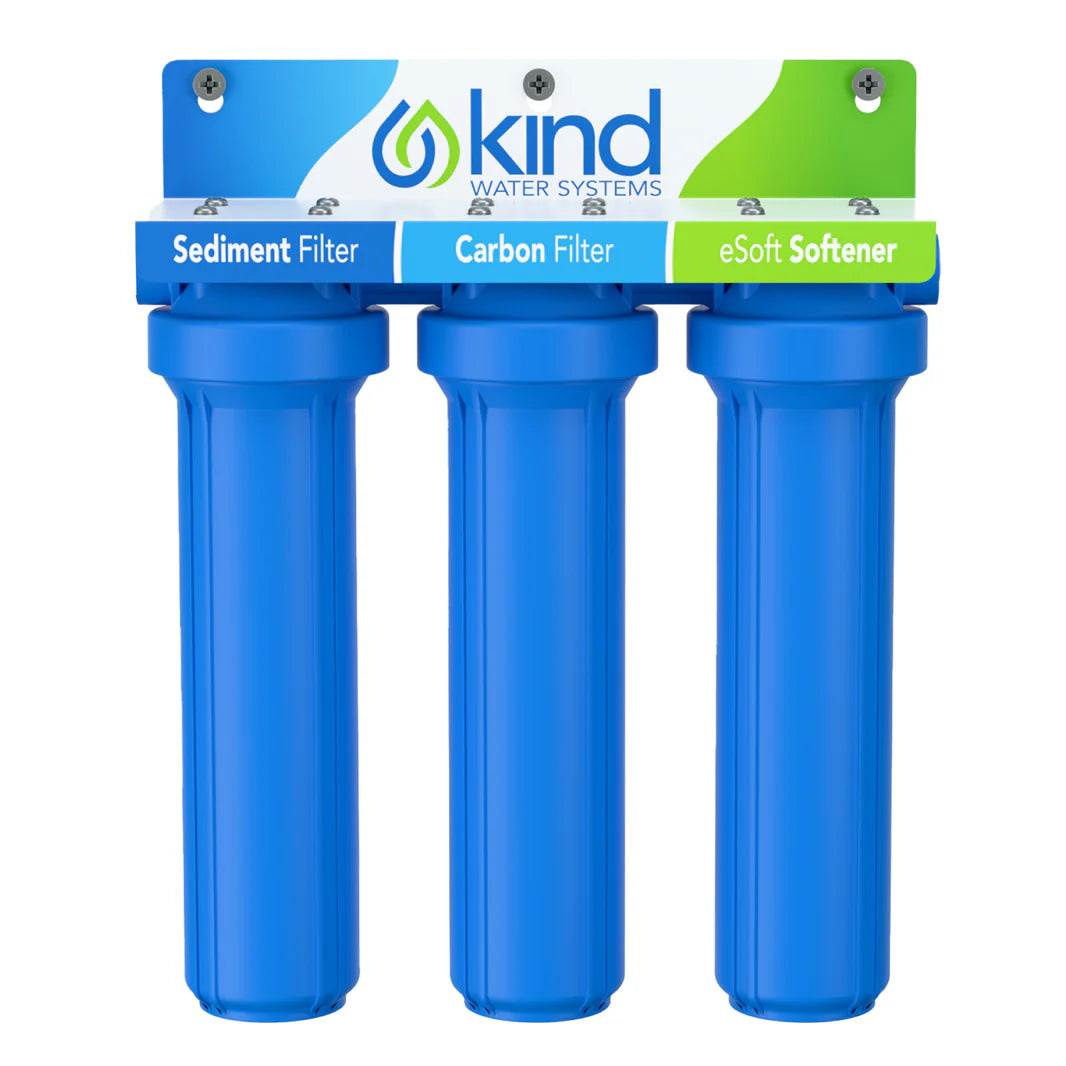
Kind Water’s E-3000 line is one of the most thoughtfully designed whole-house systems you can buy for city water, a wall-mounted, tankless unit that filters sediment and chlorine, then conditions against scale, all in a box the size of a carry-on suitcase. It costs $2,094.10 at current pricing, runs about $470–$650 a year once you include the $799.99 eSoft cartridge replacement every 3–5 years, and carries a lifetime warranty with a 120-day money-back guarantee. The catch: its “salt-free softener” doesn’t actually soften water. If you want truly soft water, you need real salt-based ion exchange, from Kind or anyone else.
Kind E-3000 FAQs
Does Kind Water actually soften water?
No. Kind’s eSoft cartridge uses template-assisted crystallization (TAC), which converts hardness minerals into microscopic crystals so they don’t stick to pipes and fixtures. It reduces scale buildup but does not remove calcium and magnesium from the water, so you won’t get the slippery feel of truly soft water. Only a salt-based ion-exchange softener does that.
How much does the Kind E-3000 cost per year to maintain?
About $470–$650 per year. The sediment and carbon filters run roughly $100–$200 per year (replaced every 6–12 months), and the $799.99 eSoft TAC cartridge is on a 3–5 year replacement schedule per Kind’s current maintenance guidance. Over ten years that totals roughly $4,700–$6,500 including the $2,094.10 purchase price.
How often do Kind Water filters need replacing?
The 20-inch pleated sediment filter and carbon block cartridge (E-100R/E-200R set, ~$124) are replaced every 6–12 months depending on your water quality. The eSoft salt-free conditioning cartridge is replaced every 3–5 years. The sediment filter is washable, which stretches its life.
Does the Kind E-3000 need electricity, salt, or a drain line?
No to all three. The E-3000 runs on water pressure alone, uses no salt, and produces zero wastewater. It wall-mounts with two plumbing connections and needs no floor space.
Is the Kind E-3000 worth it?
It depends on your water. For city water with moderate hardness where you want filtration plus scale protection in one compact, salt-free box, it’s the most integrated option we’ve researched — but at ~$4,700–$6,500 over ten years it costs more to own than tank-based alternatives like SpringWell. If you want genuinely soft-feeling water, you need a salt softener instead.
Who the Kind E-3000 is best for
- ✓ You have municipal or city water
- ✓ Your water is moderately hard, and scale damage — not how the water feels — is the complaint
- ✓ You want scale reduction without salt bags, brine discharge, or a softener’s maintenance
- ✓ You don’t have floor space for traditional tanks — this hangs on a wall, 8 inches deep
- ✓ You want a DIY-friendly install (Kind says about 40% of customers install it themselves) and ~10-minute cartridge swaps
- ✓ Your household needs real flow capacity — 15 GPM, rated for 1–5 bathrooms
The lineup: which Kind system is which
Kind sells several builds around the same core idea. Here’s how they differ:
| System | Best for | Rough price | Stages |
|---|---|---|---|
| E-3000 | City water: sediment + chlorine + scale conditioning | $2,094.10 | 3 |
| E-3000UV | Same, plus bacteria/virus protection | $3,152.92 | 4 (adds UV) |
| E-3000UV-RO bundle | Same, plus UV and a dedicated RO drinking line | ~$3,450 | 4 + RO |
| WS-6000 | Well water: sediment + chemicals + scale | ~$2,540 | 3 (tank-based) |
| Salt-based combo | City water where you want true softening | Varies | Filter + ion-exchange softener |
Prices move with sales, Kind discounts frequently, so check the current price rather than anchoring on these figures.
Deciding between the conditioning-only model and this one? See our Kind E-2000 vs E-3000 breakdown — the whole decision is one question: do you need filtration, or only scale conditioning?
Check current price for the E-3000
How the E-3000 works
Three stages, in order:
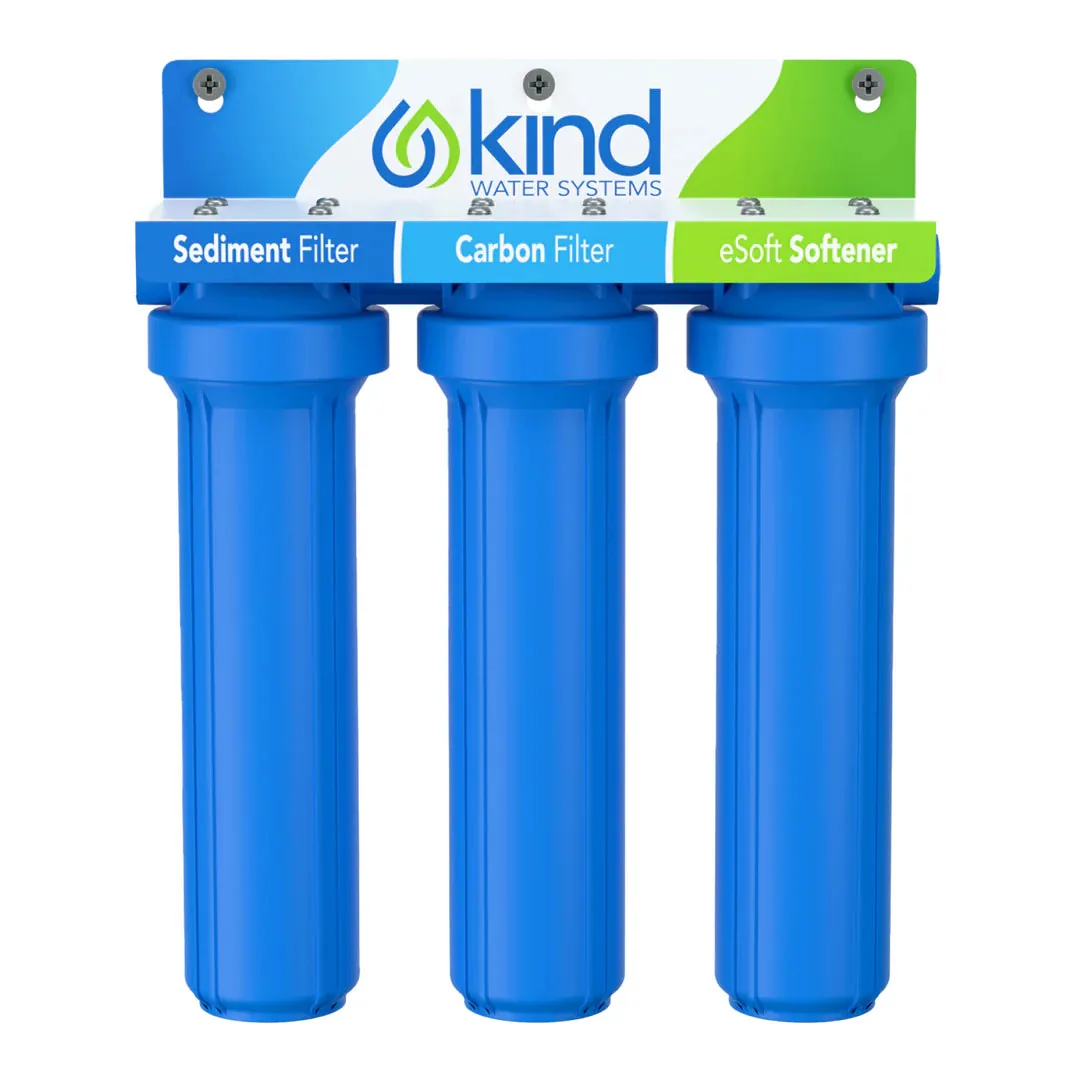
Stage 1, Sediment filter. An oversized 20-inch pleated cartridge (5-micron) that traps dirt, sand, rust, and debris. Kind rates it at 95% particulate removal. It’s washable and reusable, and the oversized format is why the system can maintain 15 GPM even as the filter loads up.
Stage 2, Carbon block filter. A catalytic coconut-shell carbon block targeting chlorine, chloramine, VOCs, pesticides, and herbicides. Kind claims 155+ contaminants addressed. Carbon block (not loose granular carbon) matters: the compressed format gives far more contact surface area, which is what actually removes chloramine and the harder-to-catch organics.
Stage 3, eSoft salt-free conditioning cartridge. This is the TAC (template-assisted crystallization) stage. It doesn’t remove hardness minerals, it converts dissolved calcium and magnesium into microscopic crystals that won’t stick to pipes, heaters, and fixtures. Kind claims 88% scale reduction. Kind’s current maintenance schedule replaces the eSoft cartridge every 3–5 years (replacement cartridge $799.99); the sediment and carbon cartridges get swapped every 6–12 months.
Key specs (E-3000)
- Flow rate: 15 GPM, enough for up to 5 showers/appliances running at once
- Home size: rated for 1–5 bathrooms (Kind’s site also says up to 6)
- Dimensions: 29″ H × 23¼” W × 8″ D, wall-mounted, zero floor space
- Connection: 1″ NPT (fits most residential mains)
- Max hardness: 1,282 PPM / 75 GPG (for conditioning, not removal)
- Operating temp: 39–113°F; indoor or outdoor installation
- Electricity: none required (E-3000); the UV models need a standard outlet
- Wastewater: zero, no brine discharge
- Certifications: NSF/ANSI 42, 61, and 372 at the component level
- Certification check: 2026-09-30 — no NSF/WQA certification claimed by the manufacturer.
- Warranty: lifetime on the system + 120-day satisfaction guarantee
- Made in: USA and Italy
Who should skip it
- Well water with iron, sulfur, or bacteria. The E-3000 is a city-water system. Kind’s WS-6000 is the well-water build (more on that below), and even that isn’t an iron/sulfur specialist, get your water tested first. See our guide on how to test your water.
- Anyone who wants genuinely soft water. See the salt-free honesty section below, this matters more than anything else on this page.
- Households wanting whole-house reverse osmosis or lead-specific filtration. The carbon block handles taste, odor, chlorine, and many VOCs, but it isn’t a heavy-metal or dissolved-solids solution.
The salt-free honesty section (read this before buying)
The most misunderstood thing about Kind’s marketing, and salt-free systems generally:
Kind’s “salt-free softener” does not soften water. Nothing about your water’s hardness number changes. If your water tests at 15 grains per gallon before the system, it tests at 15 grains after. Calcium and magnesium are still there; they’re just crystallized so they don’t form scale.
What you get: less scale buildup in your water heater and on fixtures (Kind claims 88% reduction), no slimy “soft water” feel, no salt bags, no brine, no wastewater, no electricity.
What you don’t get: the spot-free dishes, the soap-lathering, silky-hair feeling of genuinely soft water. Test strips will still show hard water. If your water is very hard and you hate what hard water feels like, TAC won’t fix that for you.
Kind isn’t hiding this, their own comparison materials describe it as “hardness crystallized” with “minerals stay.” But plenty of buyers see “softener” and assume soft water comes out. It doesn’t. Only salt-based ion exchange actually removes hardness minerals.
The honest rule: if your main complaint is scale damage to appliances and plumbing, TAC conditioning is a legitimate, low-maintenance answer. If your main complaint is what hard water feels like on your skin, in your shower, and on your glassware, buy a real softener.
Kind sells one themselves, the salt-based S-650 is rated to remove up to 99% of calcium and magnesium (the “up to 12 GPM” rating belongs to Kind’s salt-free SF-600 / WS-6000 lines, not this unit), which tells you they know the difference.
For the full breakdown: Salt-Free vs. Salt Water Softeners
Certifications, explained honestly
Kind’s systems carry NSF/ANSI 42, 61, and 372 certifications, with NSF/ANSI 55 added on the UV models. Here’s what those actually mean:
- NSF/ANSI 42, the system (or its components) is certified to reduce chlorine, taste, and odor. This is the baseline certification for a carbon filter, and Kind has it.
- NSF/ANSI 61, materials in contact with drinking water are certified not to leach harmful contaminants. A safety certification, not a performance one, but an important one.
- NSF/ANSI 372, lead-free compliance for wetted parts. Good hygiene, increasingly expected.
- NSF/ANSI 55 (UV models), the UV stage is certified for disinfection performance. This is meaningful: cheap UV add-ons often have no performance certification at all.
One caveat worth knowing: these are component-level certifications, not a full-system NSF certification of the assembled unit the way Aquasana’s Rhino carries. That doesn’t make them fake, component certification is legitimate and common, but it’s a notch below a whole-system certification, and you should know the difference.
Kind’s “155+ contaminants” claim deserves the same treatment. It refers to the range of substances the carbon media is designed to address, including many VOCs, pesticides, and herbicides. It is not 155 individually NSF-certified reduction claims. Treat it as a media capability statement, not a test report.
Warranty and guarantee
This is one of Kind’s strongest cards:
- Lifetime warranty on the E-3000 cartridge systems, “we’ll fix or replace it, period,” in Kind’s words.
- 120-day satisfaction guarantee, full refund within four months if you aren’t happy. That’s double the industry-standard 60–90 days and it meaningfully de-risks a $2,000 purchase.
- On the well-water WS systems, the terms are tiered: limited lifetime on tanks, 7 years on electronic heads, plus the same 120-day guarantee.
Fine print we couldn’t verify from public materials: the exact exclusions of the “lifetime” warranty (most lifetime warranties exclude consumables, freeze damage, and commercial use, read the store policy before buying). But as stated, this is among the best warranty packages in the category.
Maintenance and true cost of ownership
Kind’s maintenance story is genuinely simple:
- Sediment + carbon cartridges (E-100R/E-200R): replace every 12 months. The pair runs about $124 on Kind’s subscribe-and-save plan.
- eSoft conditioning cartridge: replace every 3–5 years per Kind’s current maintenance schedule (replacement cartridge $799.99).
- UV lamp and sleeve (UV models): replace annually for rated performance.
So the E-3000 costs roughly $470–$650/year to run once you include the $799.99 eSoft cartridge every 3–5 years, and Kind’s own materials say filter swaps are a 10-minute DIY job. Our Kind maintenance guide covers every replacement on the schedule. No salt bags, no service visits, no backwash cycles, no wastewater.
We have broken the full decade math out separately — E-1000, E-2000, and E-3000 purchase price plus every cartridge, annualized and per 1,000 gallons — in our Kind water systems cost breakdown.
Compare that to the alternatives: a salt softener runs $150–$400+/year in salt alone, plus water for regeneration. SpringWell’s tank-based CF1 costs only ~$40–70/year in upkeep but doesn’t condition for scale. Aquasana’s Rhino needs a $10 pre-filter swap every two months (~$60/year) plus eventual main-tank replacement.
Ten-year math on the E-3000: $2,094.10 upfront + ~$1,000–$2,000 in filters + $1,600–$2,400 in eSoft cartridges (3–5 year schedule) = ~$4,700–$6,500 over a decade, with no salt, no plumber visits, and no floor space used. Per 1,000 gallons: ~$4.29–$5.93. That’s competitive, not the cheapest, but reasonable for what it does.
Kind vs. SpringWell vs. Aquasana
The honest comparison, since these are the three names every buyer cross-shops:
For the full head-to-heads, see our Kind E-3000 vs Aquasana Rhino comparison and Kind E-3000 vs SpringWell FutureSoft — and if you’re still deciding whether Kind fits your water at all, the Kind fit check walks through it in five minutes.
| Kind E-3000 | SpringWell CF1 | Aquasana Rhino | |
|---|---|---|---|
| Design | Wall-mounted cartridges | Floor-standing tank | Floor-standing tanks |
| Upfront cost | $2,094.10 | ~$1,000–$1,200 | ~$1,000–$1,900 |
| Flow rate | 15 GPM | 9–20 GPM (sized) | ~14.6 GPM |
| Filtration | Sediment + carbon block + TAC conditioning | Carbon + KDF media tank | Sediment + carbon + KDF |
| Scale handling | TAC conditioning included | Not included (separate FS line) | Optional salt-free add-on |
| Annual upkeep | ~$470–$650 | ~$40–70 | ~$250–$500 |
| Certifications | NSF 42/61/372 (components) | NSF 42/53 (components) | Independently tested to NSF/ANSI 42 (97% chlorine reduction); tank WQA certified to NSF/ANSI/CAN 61 |
| Warranty | Lifetime + 120-day guarantee | Lifetime + 6-month guarantee | 10 years |
| Floor space | None | Significant | Significant |
Best all-in-one package: Kind. Nobody else gives you filtration and scale conditioning in a wall-mounted box with no floor footprint. If you’re in a condo, a small utility closet, or anywhere a pair of 4-foot tanks won’t fit, Kind is arguably the only serious option. The 120-day guarantee is also the most generous of the three.
Tradeoffs: upfront cost is the highest of the three for the base filtration job, and the cartridge design means higher annual filter spending than SpringWell’s million-gallon tank media. Aquasana’s full-system NSF certification is a stronger third-party credential than Kind’s component-level certs. And if you have well water with iron or sulfur, SpringWell’s WS line (air-injection oxidation) is the more purpose-built tool.
The decision:
| Your priority | Buy |
|---|---|
| Form factor + bundled scale conditioning | Kind |
| Lowest long-term cost, no scale conditioning needed | SpringWell |
| Full-system NSF certification | Aquasana |
The E-3000UV: do you need the UV stage?
The E-3000UV adds a 50-watt UV lamp in a 316L stainless chamber, certified to NSF/ANSI 55, which Kind rates at 99.9% sterilization of bacteria and viruses. It costs roughly $1,059 more than the base E-3000 ($3,152.92 vs $2,094.10, observed October 2026). Our E-3000 vs E-3000UV comparison breaks down exactly what the UV stage adds and who needs it.
Our take: on chlorinated city water, UV is insurance you will probably never need, municipal disinfection already handles microbes, and the carbon stage doesn’t reintroduce them. It makes sense if you’re on a small community system with boil advisories in its history, if someone in the home is immunocompromised, or if you just want the belt-and-suspenders version. For typical city water, we’d put that $800 toward the RO bundle instead if drinking-water quality is the concern, or just skip it.
More on UV disinfection for well water here
The well-water WS-6000
Kind’s WS-6000 (~$2,540) is the purpose-built well-water system: sediment filtration, catalytic carbon for chemicals, and eSoft scale conditioning, with Bluetooth-connected metering (“Kind Water View”) and a tank-based design rather than the E-3000’s cartridges. It’s rated septic-safe and can be installed outdoors within temperature limits.
The honest caveat: Kind’s well-water lineup is not an iron/sulfur specialist. If your well test shows significant iron, manganese, or rotten-egg sulfur, purpose-built oxidation systems (like SpringWell’s WS air-injection line) are the standard answer, a carbon + TAC system isn’t designed to solve those problems. Test first, then match the system to the test. There’s also a WS-6000UV variant if bacteria is on your test results.
What we like
- Form factor is genuinely differentiated. Wall-mounted, 8 inches deep, no floor space, nothing else in this price class does this.
- All-in-one for city water. Sediment, chlorine/chloramine, and scale conditioning in a single unit with two plumbing connections.
- Low-maintenance ownership. ~$100–$200/year, 10-minute DIY filter swaps, no salt, no backwash, no wastewater.
- Warranty and guarantee are best-in-class. Lifetime warranty plus a 120-day refund window.
- Real certifications on the things that matter (42/61/372, plus 55 on UV models), made in the USA and Italy.
What we don’t like
- “Salt-free softener” marketing. It’s TAC conditioning, not softening. Kind’s own materials are fairly clear about this, but the product naming still misleads casual buyers.
- Highest upfront cost of the three major options for the core filtration job.
- Component-level, not full-system, NSF certification. Legitimate but a notch below Aquasana’s full-system certification.
- Not a well-water problem solver. Iron, sulfur, and heavy sediment need different equipment.
- The “155+ contaminants” and “trusted by 25,000+ customers” claims are marketing figures, not independently verified test results. Treat accordingly.
The verdict
The Kind E-3000 is the best whole-house option we’ve researched for city-water households that want filtration and scale protection in a compact, low-maintenance package, and the wall-mounted design alone makes it the pick when floor space is tight. The lifetime warranty and 120-day guarantee remove most of the purchase risk.
But buy it for what it actually is: an excellent filter and scale conditioner. If you want water that feels soft, you need salt-based ion exchange, from Kind’s own salt-based combo, SpringWell, or anyone else, and no TAC system will change that.
Our rating: 4.4/5 for city water with moderate hardness and space constraints. Not recommended as a well-water iron/sulfur solution. Still deciding? Find your system in 60 seconds.
Prices and specifications are based on manufacturer-published information and third-party retailers as of September 2026 and change frequently, verify current pricing before buying.
Check the Kind E-3000’s current price — prices change often, verify live before buying.
What to do next
- Test your water — get a lab test before buying anything: how to test your water.
- Identify the treatment — match your test results to the right equipment: Water Treatment 101.
- Compare systems — filter 49 whole-house systems by your problem, flow, and budget: System Finder.
- Calculate 10-year cost — the sticker price is the cheapest part of owning a system: cost guide.
- Find your system — answer four questions and get your shortlist: Find Your System quiz.
- Compare Kind vs SpringWell — the other salt-free finalist, head to head: Kind vs SpringWell.
- Salt-free whole-house filters — every salt-free option in one roundup: best salt-free whole-house filters.
Affiliate disclosure: Pure Whole House is reader-supported. When you buy through links on our site, we may earn an affiliate commission at no additional cost to you. Commissions never influence our rankings, our verdicts, or which products we review.
Read our full affiliate disclosure
By the Pure Whole House Team