
Independent review: We may earn a commission if you purchase through our links. Our ranking is not affected by compensation. This review is based on manufacturer specifications, certification records and published pricing — not hands-on testing.
Hands-on tested: No.
The short answer
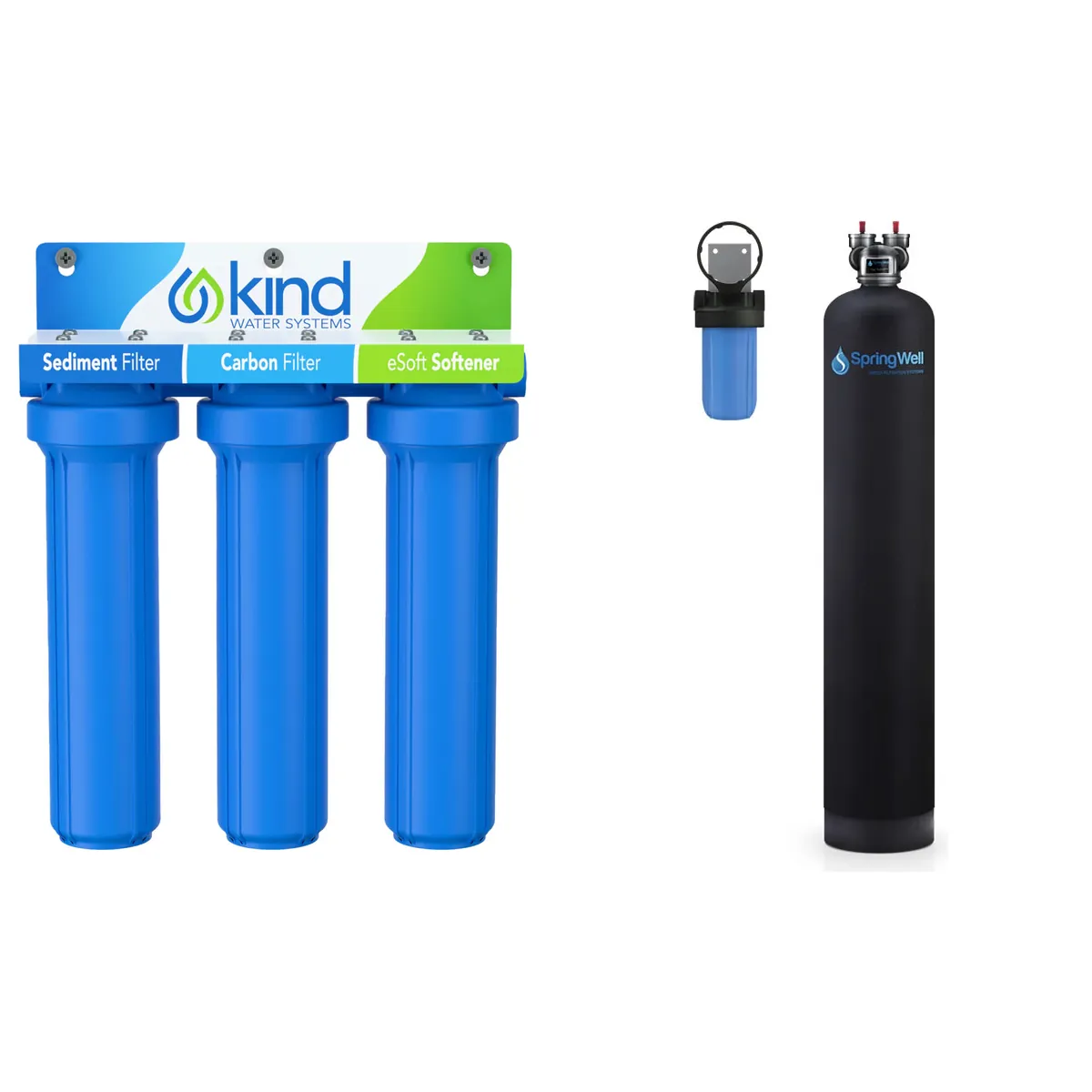
You're not comparing the same product. The Kind E-3000 is two products in one box — a whole-house filter and a salt-free TAC conditioner ($1,780–$2,094). The SpringWell FS1 FutureSoft is a conditioner only — no filtration ($1,450–$1,597).
- Best for conditioning-only buyers: SpringWell FutureSoft. Over ten years it costs roughly $2,000–$2,500 versus $4,700–$6,500 for the E-3000 — but remember the E-3000 is also filtering your water that whole time.
- Best for buyers who also need filtration: Kind E-3000. One wall-mounted unit, 15 GPM, zero wastewater, lifetime warranty.
Check current prices: Kind E-3000 · SpringWell FutureSoft
Both use template-assisted crystallization (TAC). Neither removes hardness minerals or truly softens water the way a salt softener does. Prices observed October 2026 — see the cost section for the full math.
The central frame: two functions vs one
Nearly every E-3000-vs-FutureSoft comparison online makes the same error: it puts the two sticker prices side by side as if they were rivals for the same job. They aren't. The E-3000 is a filtration + conditioning system; the FutureSoft is a conditioning-only device. Comparing their prices directly is like comparing a car's price to a motorcycle's — true, but only if you didn't need four wheels.
So before anything else, answer one question about your water: do you need filtration too? On municipal water, the usual answer is yes — chlorine or chloramine taste and odor are the most common complaints in our system database, and neither is a hardness problem. If your city water tastes like a swimming pool, the FutureSoft will do nothing about it. It isn't designed to. SpringWell sells the FutureSoft as a conditioner, and pairs it with a separate filter (or their CSF1 combo) when customers need both jobs done.
With that frame in place, here's how the two stack up — as the two different products they are. If you haven't settled whether you need salt-free conditioning at all, our salt-free vs salt softener guide covers that decision first.
Spec comparison: what you're actually buying
| Kind E-3000 | SpringWell FS1 FutureSoft | |
|---|---|---|
| What it does | Filtration + TAC conditioning | TAC conditioning only |
| Filtration | ✓ Sediment + carbon, built in | — None (pair with a filter or the CSF1 combo) |
| Scale conditioning | ✓ TAC (eSoft cartridge) | ✓ TAC (FutureSoft media) |
| Equipment price | $1,780–$2,094 | $1,450–$1,597 |
| Flow rate | 15 GPM | 12 GPM |
| Maintenance | $100–$200/yr (cartridges 6–12 mo; eSoft TAC $799.99 every 3–5 yrs) | $20–$40/yr (media claimed “lifetime” by manufacturer) |
| 10-year cost | $4,700–$6,500 | $1,950–$2,497 |
| Warranty | Lifetime | Limited lifetime |
| Guarantee | 120 days | Not published |
| Salt / electricity / wastewater | None / none / zero | None / none / zero |
| Truly softens water? | No | No |
What problem is each designed to solve?
The Kind E-3000 is built for the municipal-water homeowner with two complaints: water that tastes or smells of chlorine (or chloramine), and hard water that scales up fixtures, water heaters, and appliances. It answers both with one wall-mounted box: carbon and sediment cartridges handle taste, odor, and particulates, while the eSoft TAC cartridge conditions hardness minerals so they don't adhere as scale. See our full Kind E-3000 review.
The SpringWell FS1 FutureSoft is built for exactly one of those complaints: scale. It's a single-function TAC conditioner — hard water goes in, hardness minerals come out as micro-crystals that don't cling to pipes and heating elements, and the water itself is otherwise unchanged. If your city water tastes fine and you only care about protecting plumbing and appliances from scale, a one-function device is the honest match for a one-function problem.
The mismatch to avoid: buying the FutureSoft for taste and odor, or buying the E-3000 when you only care about scale. The first is a functional miss; the second is money spent on filtration you don't need.
What is physically different?
The E-3000 is a single wall-mounted unit: no floor space, no salt, no electricity, zero wastewater — no backwash cycle, no drain line to route. You open it and swap cartridges.
The FS1 is a floor-standing conditioner tank (1–3 bathrooms, 12 GPM): water passes through TAC media, scale gets discouraged, done. One tank, one job — versus the E-3000's integrated box doing two. Need filtration too? That's a second SpringWell tank on your floor (or their CSF1 combo), worth pricing into any honest comparison.
What does each remove?
This is where TAC marketing most often misleads, so let's be precise. Neither product removes hardness minerals. Template-assisted crystallization converts dissolved calcium and magnesium into microscopic crystals that don't stick to surfaces — the minerals stay in the water, the scale doesn't form. Your water will not test softer after either unit. If you need genuinely soft water, you need a salt-based ion-exchange softener, not TAC. Our salt-free vs salt comparison explains when each technology is the right call.
Beyond scale, the real contaminant comparison isn't TAC vs TAC (identical principle) but filtration vs no filtration — and on that axis the E-3000 is the only one playing. The FutureSoft isn't a filter and doesn't claim to be.
Flow: 15 GPM vs 12 GPM
The E-3000 is rated at 15 GPM in a single size — no sizing decision, and enough headroom for a typical 3–4 bathroom home running a shower, dishwasher, and washing machine at once. The FS1 is rated at 12 GPM for 1–3 bathrooms — plenty for smaller households. Neither figure is a lab-certified service flow — treat both as manufacturer ratings and size conservatively if your household pushes the top end.
Maintenance: the decade's real story
Maintenance is where the two diverge most — and where the E-3000's higher decade cost comes from.
Kind E-3000: $100–$200/year. The filter cartridges swap every 6–12 months in a DIY job Kind describes as a few minutes with no tools. The big-ticket item is the eSoft TAC cartridge at $799.99, replaced every 3–5 years per Kind's current product pages (superseding older “never needs replacing” materials) — two to three swaps, $1,600–$2,400, over a decade on top of routine cartridges.
SpringWell FS1 FutureSoft: $20–$40/year. SpringWell claims the TAC media is “lifetime” — no replacement cost published, no replacement interval stated. Plainly: a lifetime media claim with no published replacement cost is a manufacturer assertion, not a verified fact — there's no price on the record if reality disagrees. But on today's published numbers, the FutureSoft is close to set-and-forget: minimal upkeep, no cartridges to schedule, no $800 swaps on the calendar.
The honest tradeoff: the E-3000 asks more of your wallet and calendar because it's doing more — filtration has consumables; that's physics, not a flaw. The FutureSoft asks almost nothing because it does one thing with no consumables on the published record.
Certification: read the fine print on both
The E-3000 carries component-level NSF certifications only — materials tested, not system performance. There is no whole-system NSF performance certification on either product. Both ask you to take TAC performance on the manufacturer's word; price that uncertainty the same way for both.
Warranty
Kind backs the E-3000 with a lifetime warranty plus a 120-day satisfaction guarantee — four months to decide a $2,000 purchase earns its keep. SpringWell offers a limited lifetime warranty on the FutureSoft. The word “limited” does real work — it typically excludes consumables and media, the heart of a TAC unit — so read SpringWell's actual terms before treating the two as equivalent. On paper, Kind's lifetime coverage plus 120-day money-back window is the stronger consumer protection.
10-year cost: what the numbers mean
Here's the decade math, built only from published equipment prices and published maintenance figures:
Kind E-3000: $4,700–$6,500 over 10 years
- Equipment: $1,780–$2,094 (Kind pricing shifts often; observed October 2026)
- Routine cartridges: $100–$200/yr → $1,000–$2,000 over the decade
- eSoft TAC cartridge: $799.99 every 3–5 years → $1,600–$2,400 over the decade
SpringWell FS1 FutureSoft: $1,950–$2,497 over 10 years
- Equipment: $1,450–$1,597
- Upkeep: $20–$40/yr → $200–$400 over the decade
- TAC media: claimed “lifetime” — $0 on the published record
What the numbers mean: the FutureSoft costs roughly $2,500–$4,000 less over a decade — but the gap is the price of filtration, not a bargain on conditioning. The numbers ask one question: would you buy ten years of whole-house filtration anyway? If yes, the E-3000's premium buys something you'd pay for separately. If no, it's $2,500+ on a function you didn't want. For the full methodology behind our decade-cost formula, see our whole-house filter cost guide.
One honest caveat on the FutureSoft's low end: that $1,950 decade figure leans entirely on the “lifetime media” claim holding for ten actual years. TAC media isn't consumed the way carbon is, so the claim is plausible — but plausible isn't verified, and there's no published replacement price if reality disagrees. The E-3000's cost range, by contrast, is fully itemized: you know exactly what you'll spend and when.
Who should buy each?
Best for conditioning-only buyers: the SpringWell FS1 FutureSoft. If your water tastes fine and your one problem is scale on fixtures and appliances — the FutureSoft is the simpler, cheaper decade: roughly $2,000–$2,500 over ten years, minimal maintenance, one tank, one job. For this buyer the E-3000 is overbuying by $2,500 or more. We link to SpringWell directly at springwellwater.com — no affiliate relationship, so that recommendation costs us the commission and we're making it anyway.
Best for buyers who also need filtration: the Kind E-3000. If your city water has chlorine taste or odor and hardness, the E-3000 handles both in one wall-mounted box at 15 GPM with zero wastewater and a lifetime warranty. Check the Kind E-3000's current price. Before you buy, our is Kind right for you fit-check walks through the cases where it isn't.
A note on certification claims
Neither the Kind E-3000 nor the SpringWell FS1 FutureSoft carries a whole-system NSF performance certification on the record we could verify — the E-3000's NSF listings are component-level, and we found no independently certified system-level performance data for the FutureSoft. TAC is a legitimate, studied technology — but “legitimate technology” and “this unit certified to perform” are different statements, and neither manufacturer can make the second one here.
Frequently asked questions
Do either of these actually soften water?
No. Both use template-assisted crystallization (TAC), which converts hardness minerals into non-adhering micro-crystals so they don't form scale. The minerals stay in the water — it will not test softer. If you need true softening, you need a salt-based ion-exchange softener; see our salt-free vs salt guide.
Can the FutureSoft replace the E-3000 if I only care about scale?
Yes — and for that buyer it's the better deal. The FutureSoft is a conditioning-only device at roughly $2,000–$2,500 over ten years versus $4,700–$6,500 for the E-3000. You'd only miss the E-3000's filtration, which by definition you don't need in this scenario.
Does the FutureSoft filter chlorine or improve taste?
No. It's a TAC conditioner, not a filter — it does nothing for chlorine taste or odor, sediment, or any other contaminant. If your city water tastes like chlorine, you need filtration too: either the E-3000 (built in) or a separate filter paired with the FutureSoft, such as SpringWell's CSF1 combo.
Why is the E-3000's 10-year cost so much higher?
Because it's doing two jobs. The routine filter cartridges run $100–$200/year, and the eSoft TAC cartridge costs $799.99 every 3–5 years. Filtration has consumables; that's the physics of the second function, not a defect.
Is 12 GPM enough, or do I need the E-3000's 15 GPM?
For a 1–3 bathroom home with normal simultaneous use, 12 GPM is generally plenty. The E-3000's 15 GPM gives meaningful headroom for larger households running multiple fixtures at once.
The bottom line
Stop comparing the sticker prices — they're not measuring the same thing. The FutureSoft is the honest, cheaper answer to one problem: scale, at roughly $2,000–$2,500 over ten years. The E-3000 answers two — filtration plus scale — in one wall-mounted box at $4,700–$6,500. Match the product to the number of problems you have, and the choice makes itself.
Need filtration and conditioning together? Check the Kind E-3000's current price. Only fighting scale? See the FutureSoft at SpringWell (direct link — no affiliate relationship). Still deciding? Our system finder puts both side by side with the full 49-system database, alongside our best whole-house filters and best salt-free picks.