
Independent review: We may earn a commission if you buy through our links. This review is based on manufacturer specifications, certification records, and published pricing — not hands-on testing.
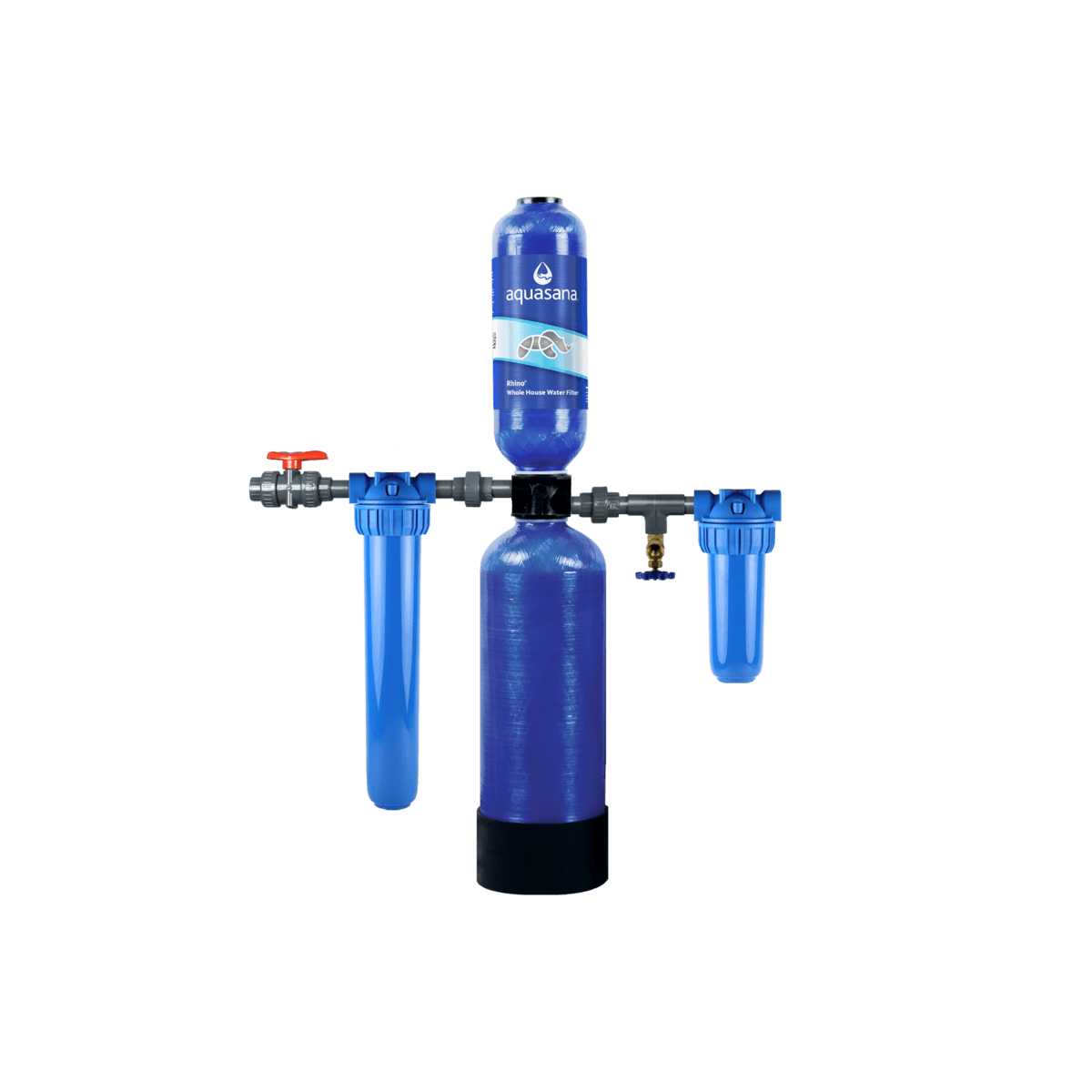
The Aquasana Rhino EQ-1000 is the best-known whole-house filter in America — the one your neighbor probably has. It’s a tank system: a 20-inch pre-filter, a large carbon/KDF media tank, and a post-filter, sold as a single bundle for $1,998 (MSRP) before installation — Aquasana’s $999 sale ended in October 2026.
The single most important sentence in this review: Aquasana says the EQ-1000 is “independently tested to NSF/ANSI Standard 42 to remove up to 97% of chlorine.” Read that again. Tested to, not certified to. That one-word difference is the difference between a lab running a protocol once and a certification body auditing the product on an ongoing basis. Our September 30, 2026 check of the live NSF, WQA, and IAPMO directories found no system-level listing for the EQ-1000. Everything else in this review flows from what that means and doesn’t mean. Check the current EQ-1000 price →
Find your system
Is a whole-house carbon filter what your water needs? Answer a few questions about your water source and household size, and we narrow 49 systems down to your shortlist.
Short answer
- Best for: city-water homes (3–4 baths) that want chlorine, taste, and odor handled with minimal intervention.
- The numbers: $1,998 equipment (MSRP; observed Oct 15, 2026), $300–$600 install, $100–$120/yr upkeep. Estimated 10-year cost: $3,298–$3,798 ($330–$380/yr). Per 1,000 gallons: ~$3.00–$3.47.
- Flow: 7.0 GPM service flow (14.6 peak). Fine for 3–4 baths; large homes should size up (sizing guide).
- Certification: “independently tested to NSF/ANSI 42” — tested, not certified. No live system-level NSF/WQA/IAPMO listing found.
- Certification check: 2026-09-30 — no NSF/WQA certification claimed by the manufacturer.
- Don’t buy it for chloramine (get the Rhino Chloramines variant instead), PFAS, hardness, or bacteria — this system does none of those.
The short version
The EQ-1000 does exactly one job — making chlorinated city water taste and smell like nothing — and the mechanism (coconut-shell carbon plus KDF media in a big tank) is the right tool for that job. The pre-filter catches sediment, the tank does the chemical work, the post-filter polishes. Maintenance is swapping the 20-inch pre-filter roughly every two months and the post-filter every six, which is where the $100–$120/yr upkeep comes from.
The price puts it at the premium end of the market at the current $1,998 MSRP — well above the SpringWell CF1, closer to a Kind E-1000 bundle than its old $999 promo price. The value case now depends on catching one of Aquasana’s promos; at the $999 sale price it was the market’s sweet spot. The 10-year warranty is genuine. The certification story is the thing to understand before buying, covered next.
Tested vs. certified: the distinction that matters
Here’s the skeptical read, with numbers. NSF/ANSI 42 certification means an accredited body tested the product, audits the factory, and locks the formulation — the claim is monitored. “Independently tested to NSF/ANSI 42” means a lab ran the 42 protocol and the product passed that test, that time. It’s evidence, not certification, and the two get conflated constantly in this industry’s marketing.
Is the 97% chlorine-reduction claim plausible? Yes — granular activated carbon reliably removes chlorine; the chemistry isn’t controversial. The question isn’t whether carbon works, it’s whether you want your $1,000+ purchase backed by ongoing third-party verification. Of the 49 systems in our certification database, only two carry verifiable system-level certifications, and the EQ-1000 isn’t one of them. Neither is the SpringWell CF1 or the Kind E-1000, for context — this is an industry-wide posture, not an Aquasana-specific scandal. But “everyone does it” doesn’t make tested into certified.
The case for it
- Chlorine, taste, and odor — the core job. Carbon + KDF is the standard, effective approach for chlorinated city water.
- Long tank life. The media tank lasts years; you’re swapping prefilters, not the system.
- Deep ecosystem. The EQ-1000 is a platform: add the SimplySoft conditioner (EQ-1000-AST), UV (EQ-1000-AST-UV), or go whole-hog with the well-water bundle. Our Aquasana vs Kind comparison breaks down the bundle math.
- 10-year warranty. Limited, but real, and longer than the 1-year warranties common at lower prices.
- Widely installed. Any plumber has seen one, which matters when you need service.
The downsides
- Prefilter treadmill. Every two months for the 20-inch pre-filter is more hands-on than SpringWell’s near-zero maintenance. At $100–$120/yr, upkeep is 3–4× the CF1’s.
- 7.0 GPM service flow is modest. Fine for 3–4 baths; a 5-bath home running showers, laundry, and dishwasher simultaneously should look at higher-flow options.
- Chloramine needs the other model. Standard carbon removes chloramine slowly. If your utility uses chloramine — check your water report — you want the Rhino Chloramines variant, not this one.
- No PFAS, softening, or disinfection claims. PFAS-concerned buyers should look at Aquasana’s HealthShield line; hardness needs a softener or conditioner.
- Tested, not certified (see above).
The 10-year math
- Aquasana Rhino EQ-1000: $3,298–$3,798 ($330–$380/yr)
- SpringWell CF1: $1,494–$2,144 ($149–$214/yr) — cheaper to buy and run, less maintenance
- Kind E-1000: $2,160–$3,280 ($216–$328/yr) — wall-mount, salt-free conditioning included (SpringWell vs Kind head-to-head)
- iSpring WGB32B: $1,860–$3,411 ($186–$341/yr) — cheapest upfront, cartridge treadmill — see our iSpring WGB32B vs Aquasana Rhino head-to-head
The EQ-1000 is the most expensive to run of the four except the Kind, driven by the prefilter schedule. You’re paying for the brand, the warranty, and the ecosystem — reasonable if you value those, but the math should be conscious. Full methodology in our System Finder methodology. Check the current EQ-1000 price →
How it compares
| Aquasana Rhino EQ-1000 | SpringWell CF1 | Kind E-1000 | iSpring WGB32B | |
|---|---|---|---|---|
| Best for | City chlorine, 3–4 baths | City chlorine, 1–3 baths | Chlorine + salt-free conditioning | Budget 3-stage city filter |
| Price | $1,998 | $924–$1,144 | $770–$980 | $420–$441 |
| Flow | 7.0 GPM service | 9.0 GPM service | 15.0 GPM service | 15 GPM peak |
| Annual upkeep | $100–$120 | $27–$40 | $124–$200 | $114–$227 |
| 10-year cost | $3,298–$3,798 | $1,494–$2,144 | $2,160–$3,280 | $1,860–$3,411 |
| Certification | Tested to 42 (not certified) | None claimed | None claimed | Tested-to-standard (retailer wording) |
| Warranty | 10-year limited | Lifetime tanks/valves | Lifetime + 120-day guarantee | 1-year manufacturer |
Choosing between Rhino models themselves? Our EQ-600 vs EQ-1000 comparison covers the differences (note the EQ-600 is discontinued). For the head-to-head with SpringWell, see SpringWell vs Aquasana.
Test first: when this is NOT the answer
- Chloramine water → Rhino Chloramines variant, not this one.
- Well water with iron/sulfur/bacteria → different equipment entirely; start with our well-water guide.
- PFAS concern → the EQ-1000 makes no PFAS claim; see our PFAS picks.
- Hard water → this doesn’t soften or condition; see hard-water options.
Buying notes
Buy the configuration that matches your water — the base EQ-1000 for chlorine, the -AST if you also need salt-free scale conditioning, the -UV if you’re on a well with bacteria concerns. Professional installation ($300–$600) is typical; the system is heavy and the plumbing isn’t a first DIY project. Our link below goes to the exact EQ-1000 model page via our affiliate partner (we may earn a commission).
Check current price for the Aquasana Rhino EQ-1000 →
Frequently asked questions
Is the EQ-1000 NSF certified?
No. It is “independently tested to NSF/ANSI Standard 42,” which is not the same as certification. No live system-level NSF, WQA, or IAPMO listing was found as of September 30, 2026.
How often do the filters need changing?
Per Aquasana: the 20-inch pre-filter roughly every 2 months, the post-filter every 6 months. Budget $100–$120/yr.
Will it remove chloramine?
Not effectively — standard carbon is slow on chloramine. Get the Rhino Chloramines variant if your utility uses chloramine.
EQ-1000 vs SpringWell CF1?
The CF1 costs less upfront and far less to run, with a lifetime warranty; the Rhino has the deeper add-on ecosystem and wider installer familiarity. See the full comparison.
Compare the data
All 49 systems side by side. Filter by price, flow rate, certifications, and estimated 10-year ownership cost.
What to do next
- Test your water — get a lab test before buying anything: how to test your water.
- Identify the treatment — match your test results to the right equipment: Water Treatment 101.
- Compare systems — filter 49 whole-house systems by your problem, flow, and budget: System Finder.
- See the top picks — our best whole-house water filters roundup compares seven systems side by side.
- Calculate 10-year cost — the sticker price is the cheapest part of owning a system: cost guide.
- Find your system — answer four questions and get your shortlist: Find Your System quiz.
Sources & Verification
- Aquasana, Rhino EQ-1000 product and specification page (“independently tested to NSF/ANSI Standard 42 to remove up to 97% of chlorine”; 20″ pre-filter / post-filter schedule; 10-year limited warranty): aquasana.com.
- NSF International, Drinking Water Treatment Units certified listings search; WQA product directory; IAPMO R&T directory — no system-level listing found for Aquasana Rhino EQ-1000 (checked 2026-09-30).
- Internal: Aquasana vs Kind · SpringWell vs Aquasana · EQ-600 vs EQ-1000 · Kind E-3000 review · chlorine & chloramine guide
Research checked: October 2026. No hands-on testing was performed; claims trace to the manufacturer specifications, certification directories, and pricing above.
By the Pure Whole House Team